The Earthshot Prize 2027 Build a Waste-Free World

Ten designs for a waste-free world

Team V-Flock brings together ten Taiwanese designs that reduce the need for single-use materials in daily life.

We rethink familiar tasks such as brewing coffee, cushioning glass bottles, growing seedlings and sealing cartons. Each project shows a way to reduce waste at the point of use.

Loofah in three designs

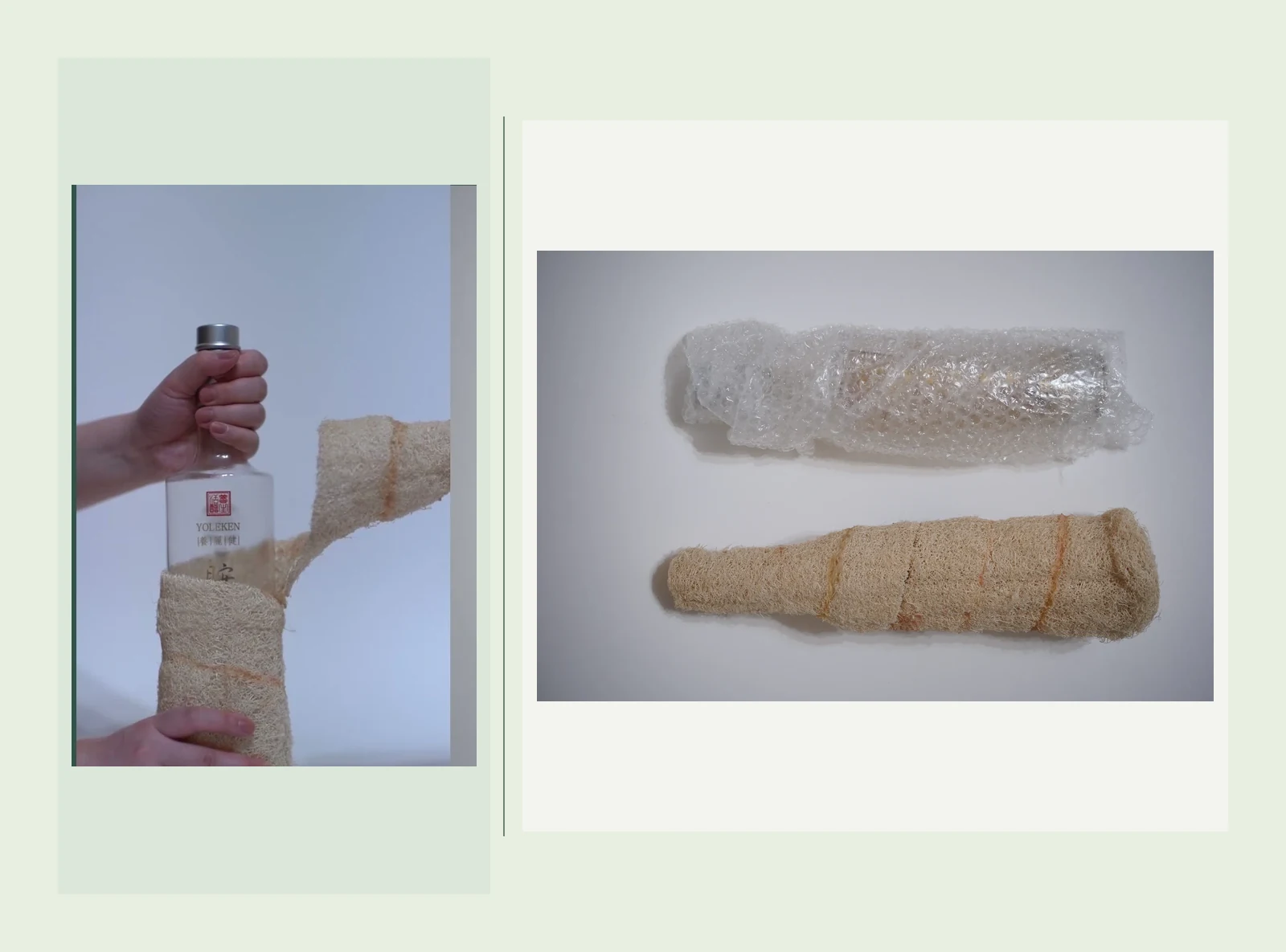
A glass bottle in an open loofah sleeve next to a comparison of loofah and bubble-wrap sleeves.
Loofah Bottle Protection Read this project

The ten projects

Spring Coffee Dripper

Brew ground coffee straight over a cup, then rinse the spring filter for the next brew.
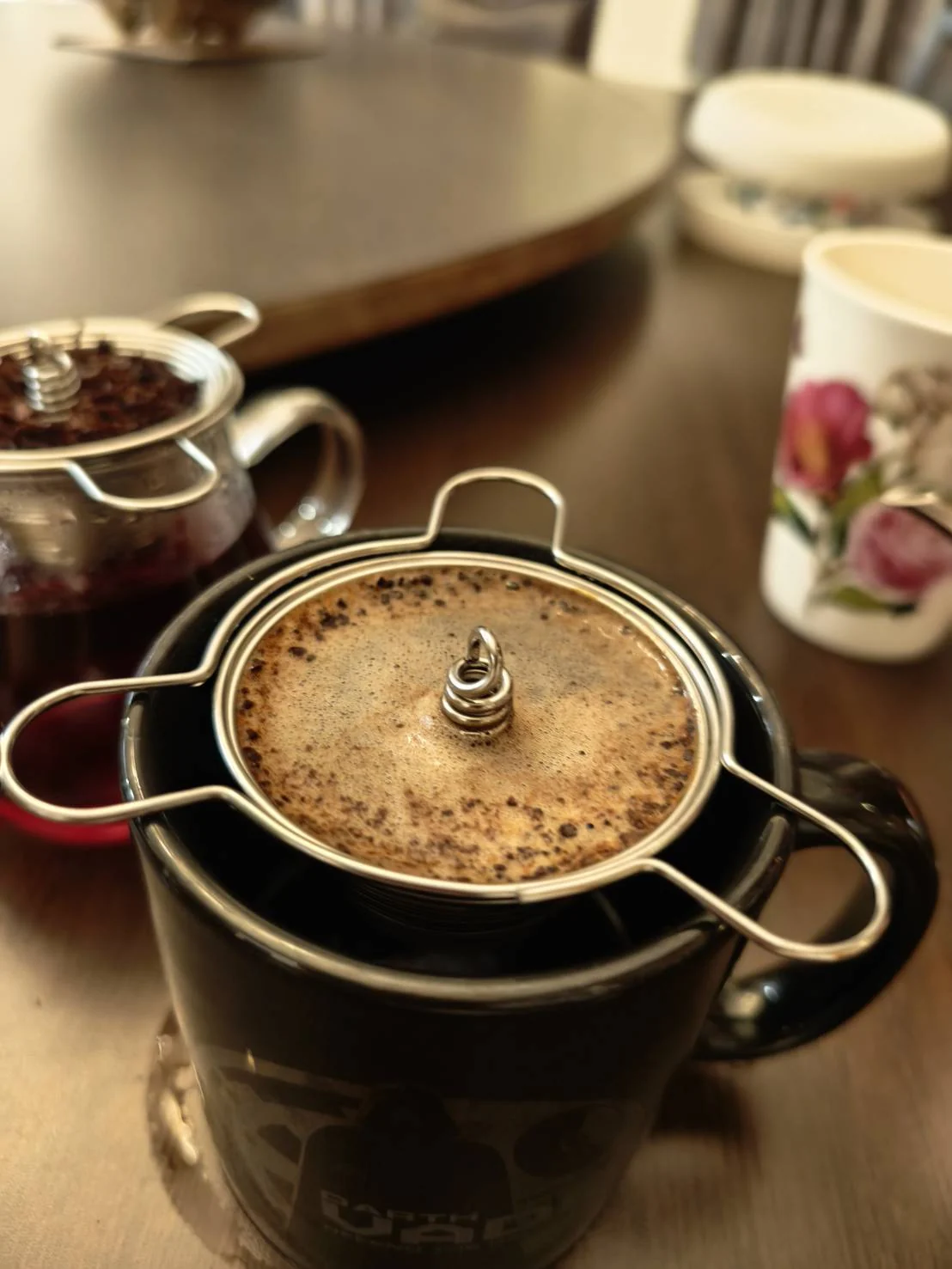
The spring coffee dripper filled with coffee grounds over a black cup.
Three wire loops rest on the cup rim while hot water passes through the coffee bed in the steel coil.

A spring that holds the filter shape

The spring forms the brewing chamber and the metal loops rest on the rim of the cup. The coil holds the grounds while brewed coffee runs through into the cup.

Designed to replace
Individually packaged drip coffee bags and their disposable filter paper.
Progress to date
Working product and a 2026 Concours Lépine gold medal.
What we plan to measure
A household trial could count how many individually wrapped filters people replace, and track how often they clean and reuse the dripper.
Design notes and sources

Start with ground coffee

Each packaged drip bag combines a portion of coffee with a filter and wrapper. The spring dripper works with ground coffee from a larger supply, so the filter can stay in use from cup to cup.
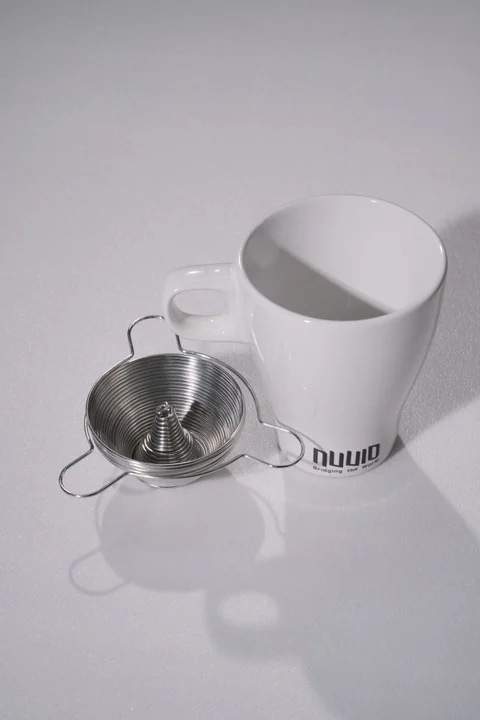
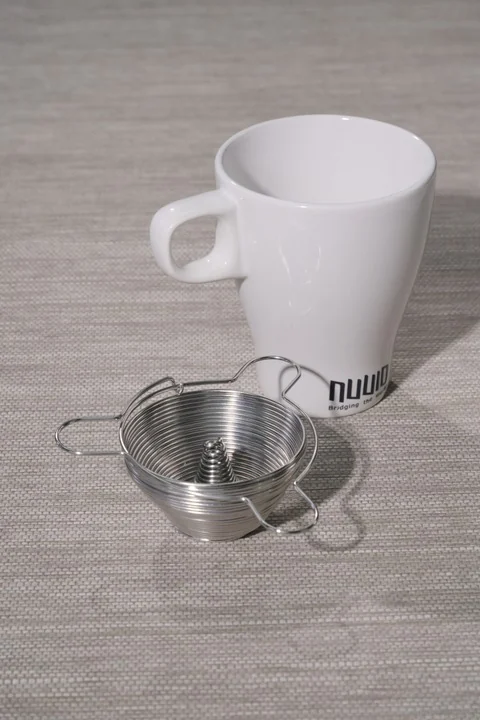
The empty metal spring coffee dripper beside a white cup.
The bare steel coil and its three supports are visible beside the cup before brewing.
The spring coffee dripper shown empty beside a white cup.
The dripper off the cup. The gaps in the coil form the filter.

Brew, lift, rinse

  1. Set the dripper over a cup.
  2. Add ground coffee and pour water through the spring-shaped filter body.
  3. Lift the dripper after brewing and rinse the grounds away for the next use.
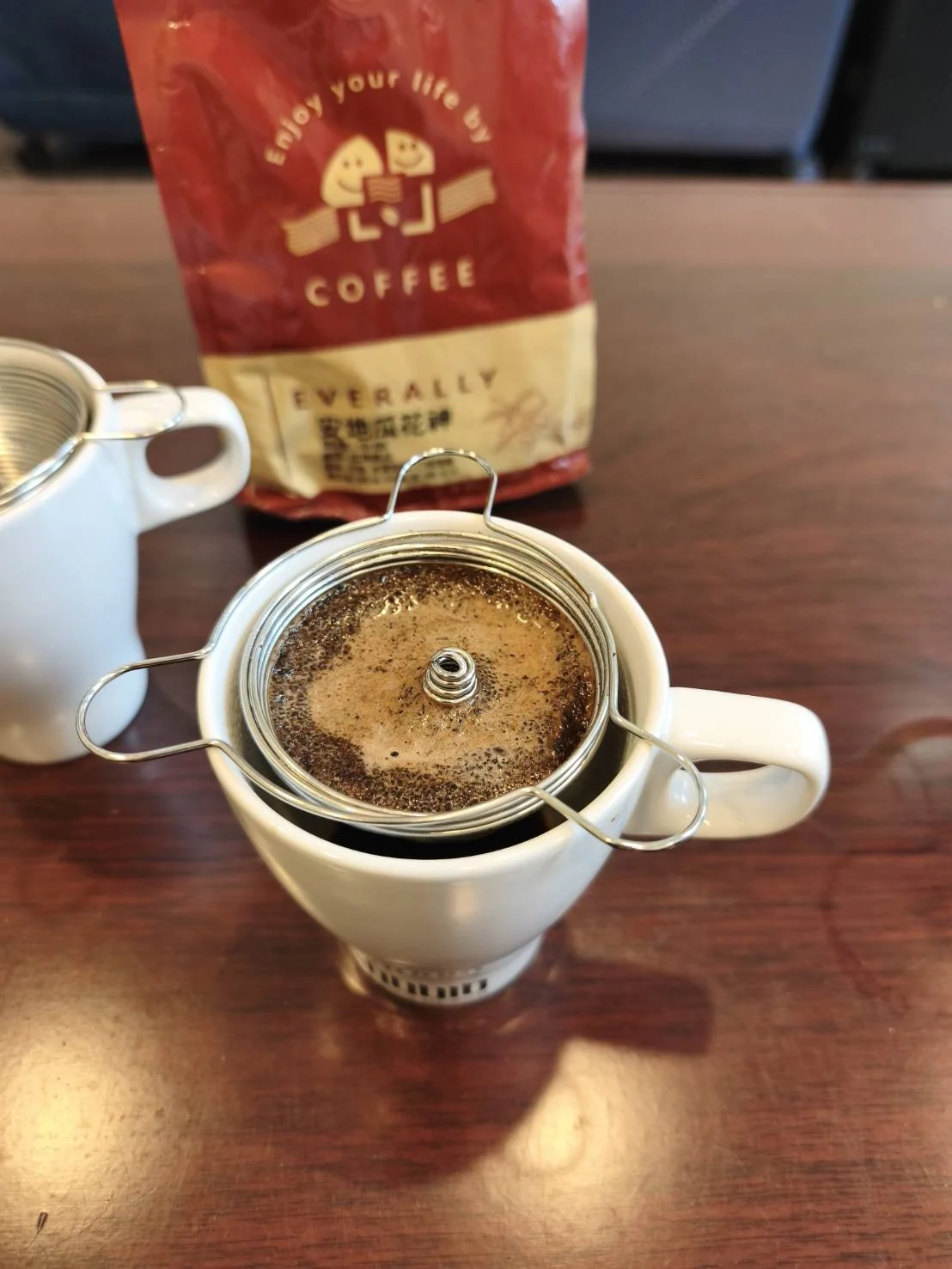
Coffee blooming in the stainless-steel spring dripper above a white ceramic cup.
During the pour, the coffee bed blooms inside the spring coil above a white cup.

Documented progress

Recognition
The 2026 Taiwan InnoTech Expo patent exhibit lists the coffee dripper under Color Focus Co., Ltd. with a 2026 Paris International Inventions Exhibition gold-medal reference.

2026 Paris entry
The Taiwan delegation lists the stainless-steel spring coffee dripper as entry 15.
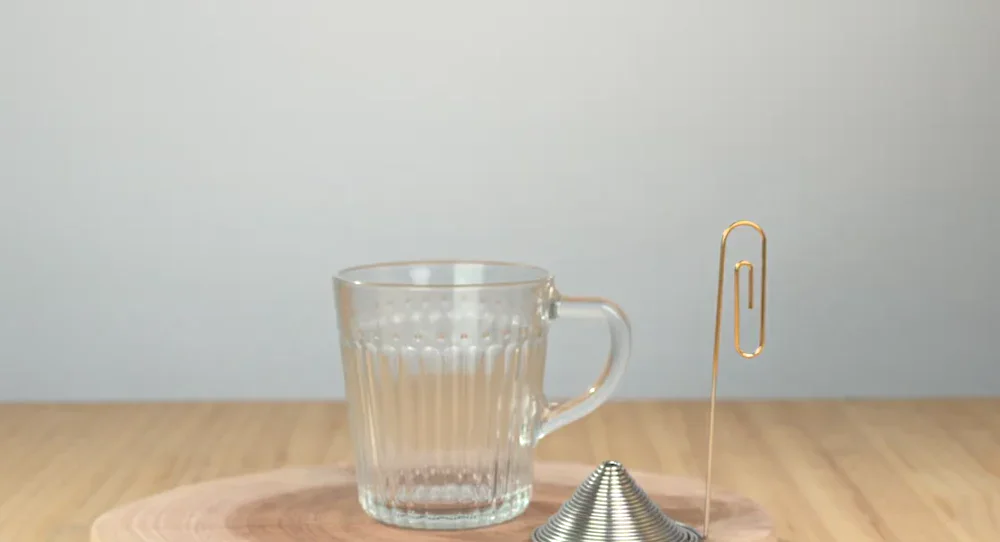
Spring Tea Infuser

Brew loose tea or flowers in a handled cup. The cone holds the leaves back as you pour. Pull open the spring to rinse it for the next brew.

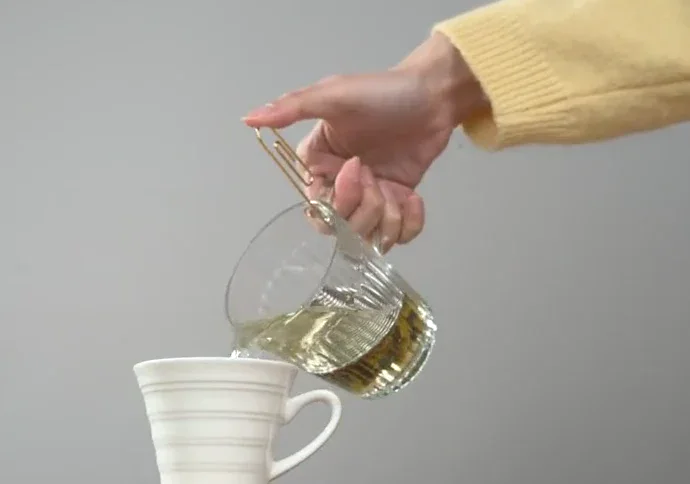
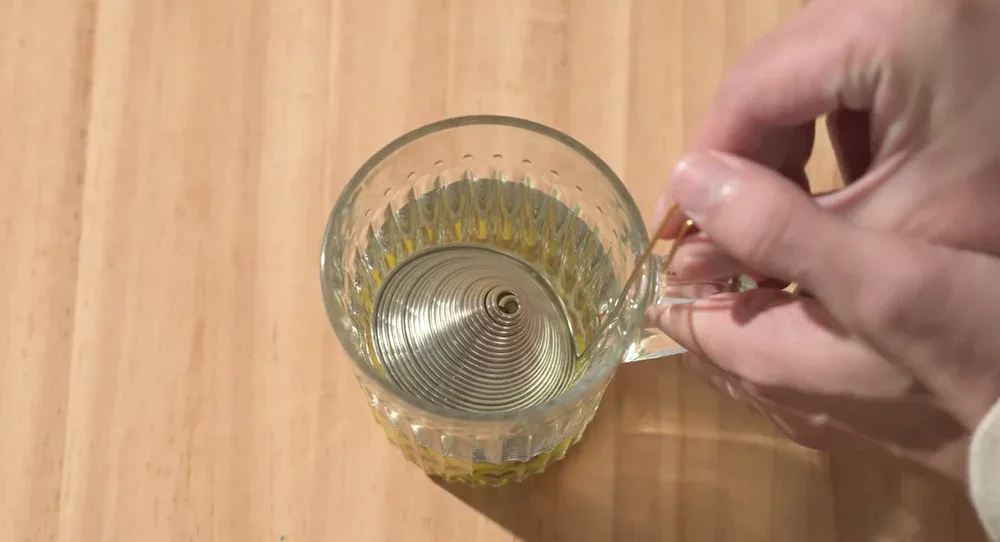
A hand holds the long handle of a conical spring infuser inside a glass cup.
The cone sits inside the glass, with its long handle held in place so the tea can be poured.

The cone stays with the cup

The low conical coil sits over the tea. Its closely wound wire leaves a path for the tea liquor while holding the leaves back inside the cup.

When it is time to serve, the long handle turns beside the cup handle. Holding both together lets the cup and infuser tilt as one, so the tea can be poured without first moving the leaves into another filter.

Designed to replace
Single-serve tea bags and their individual wrappers.
Progress to date
Working product, photographed through brewing, pouring and rinsing.
What we plan to measure
A repeat-use trial could track how often people switch from wrapped tea bags to loose tea, alongside fit and cleaning effort.
Design notes

Loose tea, one everyday cup

An individually wrapped tea bag adds a filter and an outer wrapper to each serving. This infuser fits inside a handled cup and lets you brew from loose leaves or flowers. One coil can serve many cups of tea.

The spring infuser and a clear handled cup arranged on a wood board.
The setup before brewing. The tapered coil and long wire handle are separate from the glass.
Tea is poured into a small cup while the infuser handle is held beside the glass.
A hand holds the infuser handle against the glass as the brewed tea flows into a second cup.

Brew, pour, rinse

  1. Add loose tea or flowers to a handled heat-resistant cup, then place the spring infuser over it.
  2. Add hot water and let the tea steep. Turn the handle beside the cup handle and hold both while pouring.
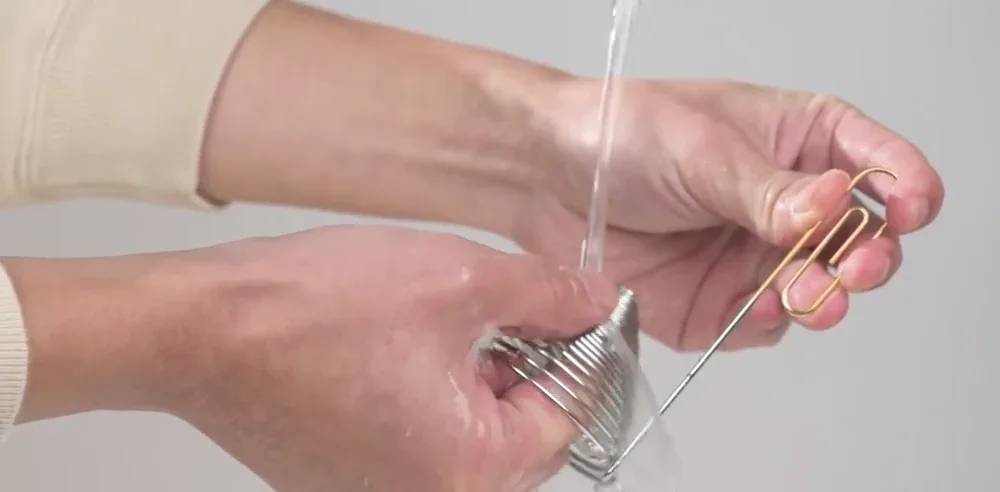
  3. After the infuser has cooled, pull the spring open and rinse through the coil gaps before the next brew.
Hands rinse the spring coil under running water.
Running water passes through the exposed gaps as the coil is rinsed for the next brew.

Documented progress

Working demonstration
The HOZZY demonstration follows one full use cycle, from fitting the cone in a glass cup to pouring the tea and rinsing the coil.

Loofah Bottle Protection

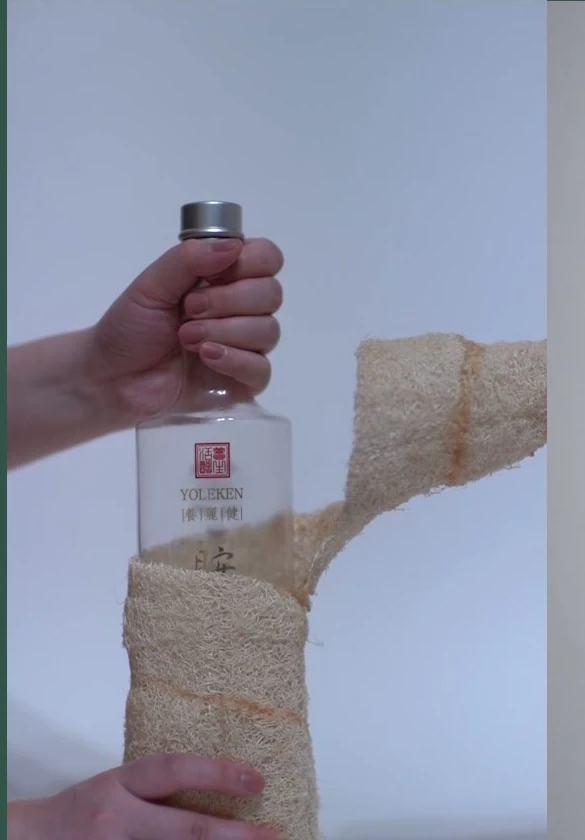
A sleeve cut from natural loofah wraps a glass bottle. After unpacking, the same piece can be used as a scrubber.

A glass bottle in an open loofah sleeve next to a comparison of loofah and bubble-wrap sleeves.
Left, a glass bottle in the spiral-cut loofah sleeve. Right, the loofah prototype laid out below its bubble-wrap counterpart.

Cut and formed to wrap around glass

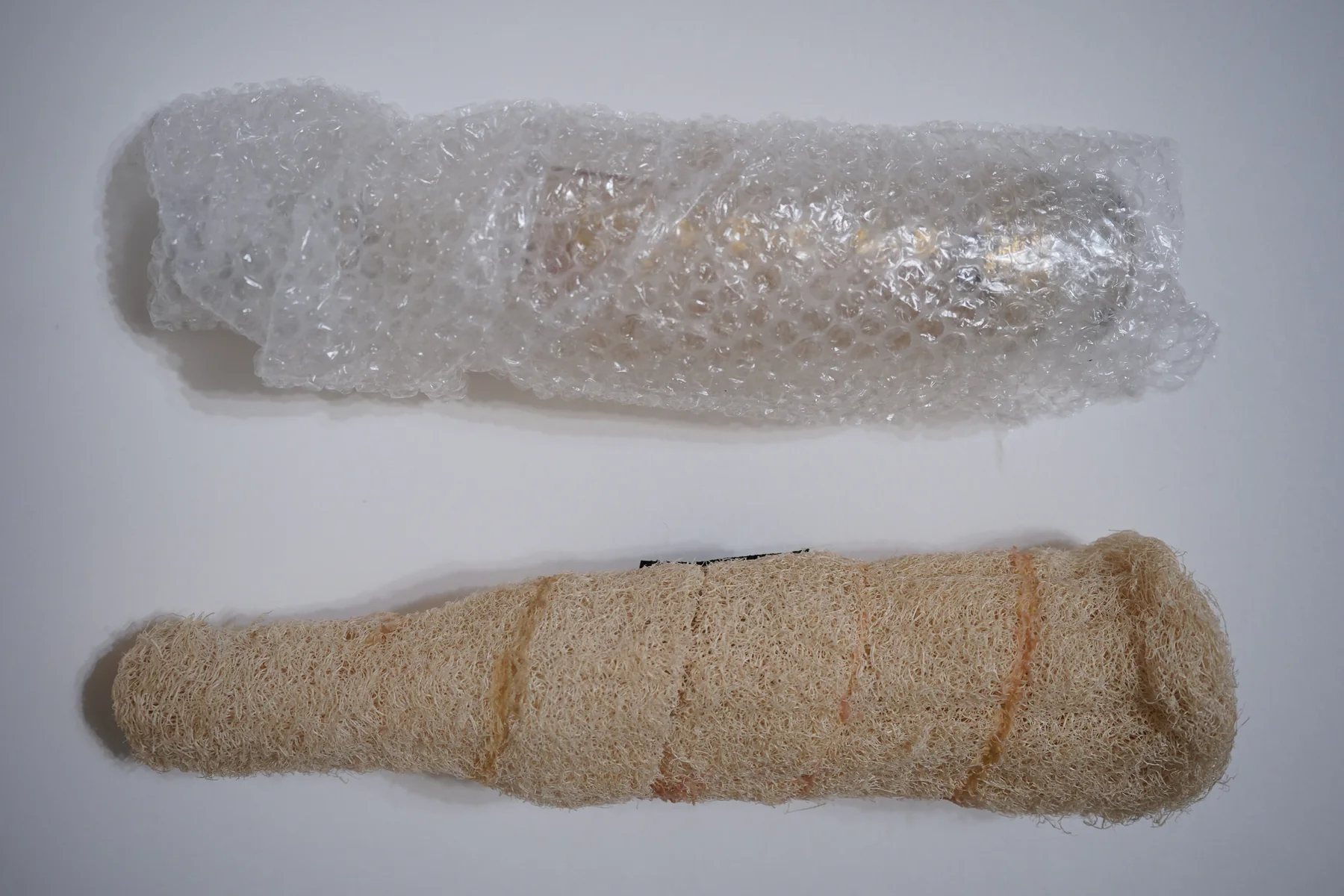
A spiral cut lets the fibre layer open far enough to take the bottle and wrap around it. The prototype places the loofah sleeve beside a bubble-wrap sleeve for the same kind of object.

Designed to replace
Bubble wrap and expanded-plastic cushioning used around fragile bottles.
Progress to date
Bottle sleeve prototype and exhibition records.
What we plan to measure
A side-by-side shipping trial could compare package weight, packing time and breakage with the incumbent cushioning. It could also track how many recipients reuse the sleeve.
Design notes and sources

Replace the layer around the bottle

A glass bottle needs cushioning in transit. The team used the open fibre structure of a mature loofah to make a sleeve shaped for the bottle. The sleeve wraps around the glass where bubble wrap or foam would normally go.

A hand lifts a glass bottle while the spiral-cut loofah sleeve unfolds around it.
A frame from the prototype demonstration shows the sleeve opening around the bottle as it is lifted.

After unpacking, use it to scrub

The packaging was designed with a second use in mind. Once the bottle is out, the loofah sleeve can serve as a scrubber.

A close view of bubble wrap above the open fibre network of a loofah sleeve.
Bubble wrap above and the loofah sleeve below show two different structures for cushioning a bottle.

Documented progress

Public exhibition report
Central News Agency reported on National United University’s loofah packaging work at the 120th Concours Lépine in 2021 and described glass-bottle sleeves among its uses.

Loofah Seedling Plugs

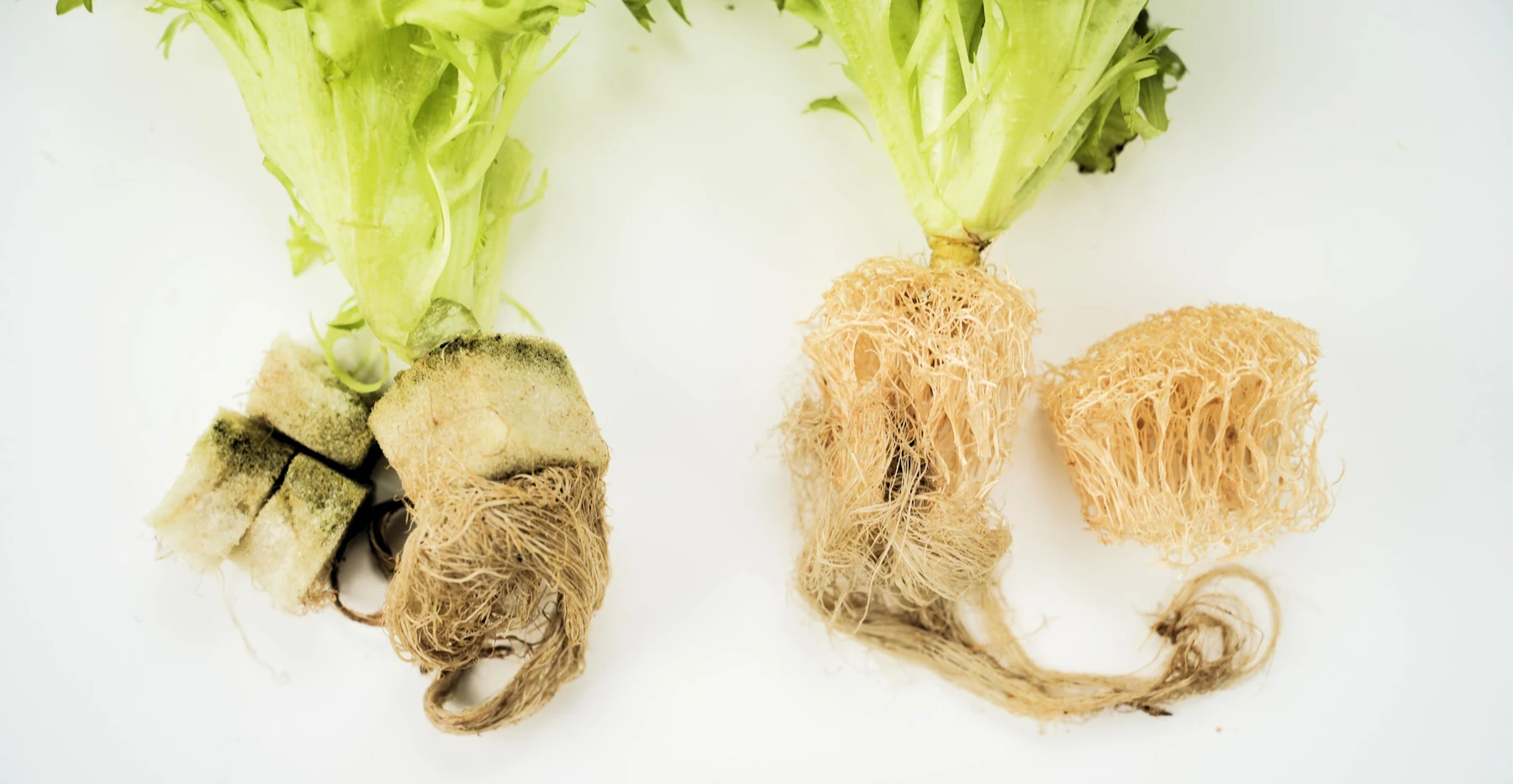
Valofresh shapes mature loofah fibres into small plugs that hold seedlings in a hydroponic tray, in place of conventional foam blocks.

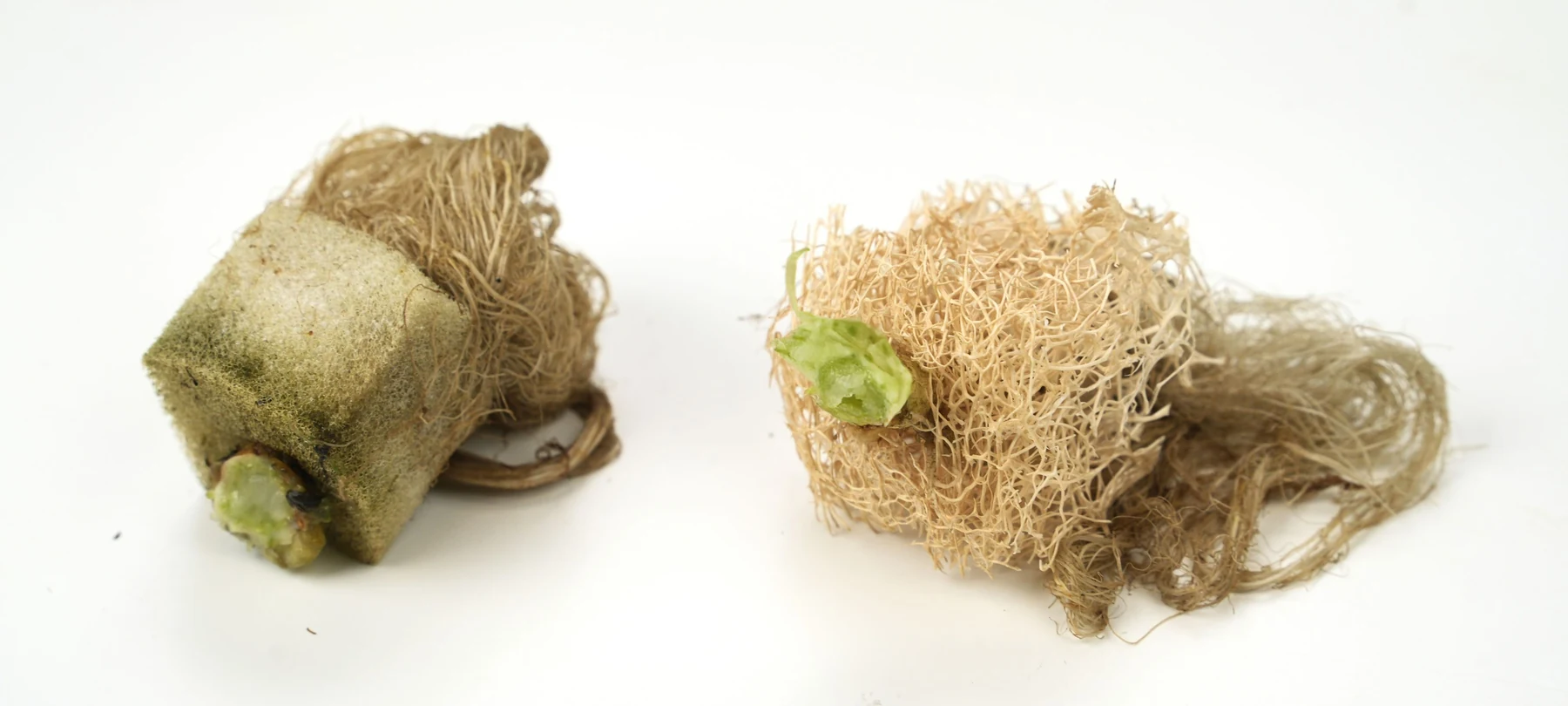
Leafy seedlings rooted in loofah fibre plugs beside conventional foam-based plugs.
Seedlings in conventional foam at left and in loofah fibre at right show how the growing plugs compare in shape.

Roots grow through the fibres

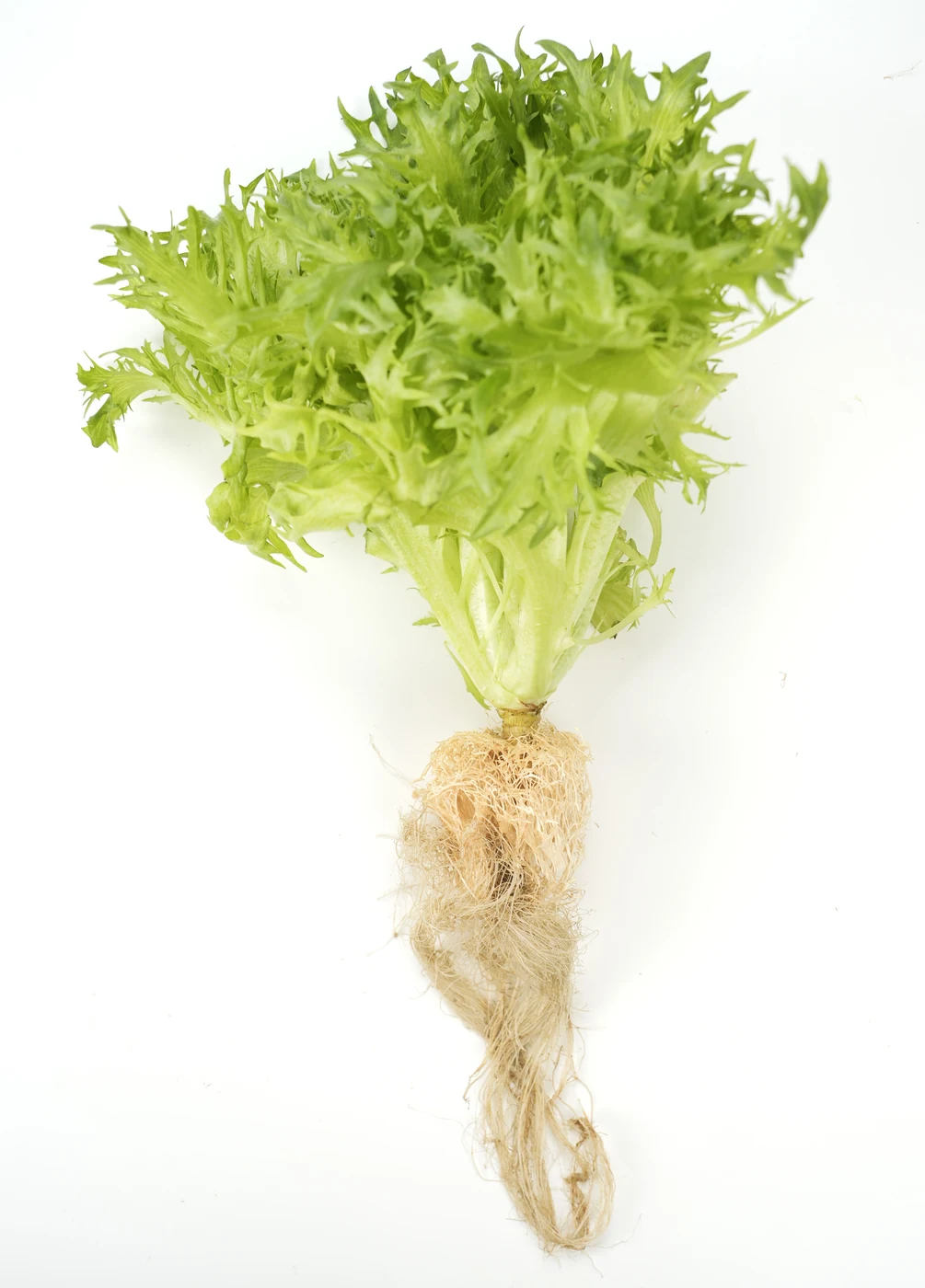
The growing samples show leaves above the plug and roots extending through the fibre below it. The team has been exploring different fibre densities for different crops.

Designed to replace
Synthetic or inorganic foam starter blocks used to anchor seedlings in hydroponic systems.
Progress to date
Growing samples and 2024 Concours Lépine gold medal.
What we plan to measure
A controlled growing trial can compare germination, plant survival and plug use under the same conditions, and record where the plugs go after harvest.
Design notes and sources

Start at the seedling tray

Young plants in a vertical farm need a plug to hold them in place as their roots develop. Loofah has an open fibre structure that can be cut to fit the holes in a growing tray.

Shape the network around the seed

In the 2024 entry, the team reports preparing the fibre and cutting it into one-inch squares. For smaller seeds, it used cotton or another absorbent material to help hold the seeds in place.

A close view of an open loofah fibre plug beside a foam block, with a small plant and roots visible.
A cut foam block beside the open loofah plug, with fine roots visible through the natural fibre.
A leafy plant photographed with a loofah plug and exposed root area below it.
A leafy seedling removed from the growing setup, with the loofah plug and exposed roots left attached.

Account for the used plugs

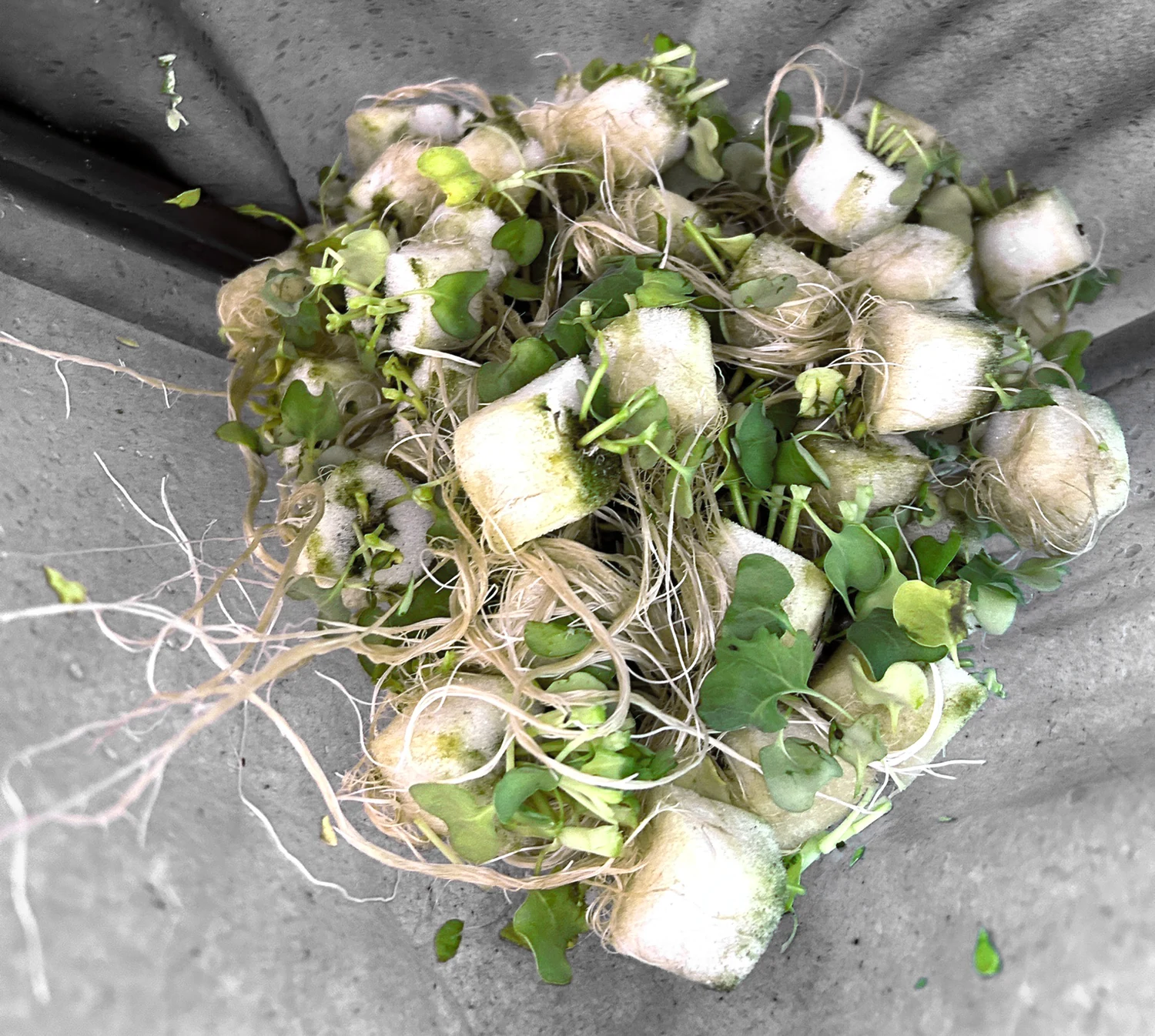
At harvest, the growing system also has to handle the spent plugs. A farm trial can follow the material through removal, collection and its next destination.

A field photograph of young plants, roots and growing plugs collected together on a dark surface.
A field photograph of several seedlings after removal, with the plugs and exposed roots gathered together.

Documented progress

2024 Paris gold, publicly reported
The Taoyuan City Agriculture Bureau's 25 May 2024 report identifies Guangxian Greens (光鮮綠蔬) as a gold-medal recipient at the 2024 Paris World Invention Exhibition and describes natural loofah fibre replacing inorganic foam blocks.

A vertical farm use case
Valofresh uses multilayer growing trays and a nutrient-film hydroponic system at its controlled indoor farm.

Loofah Insole and Toe Support

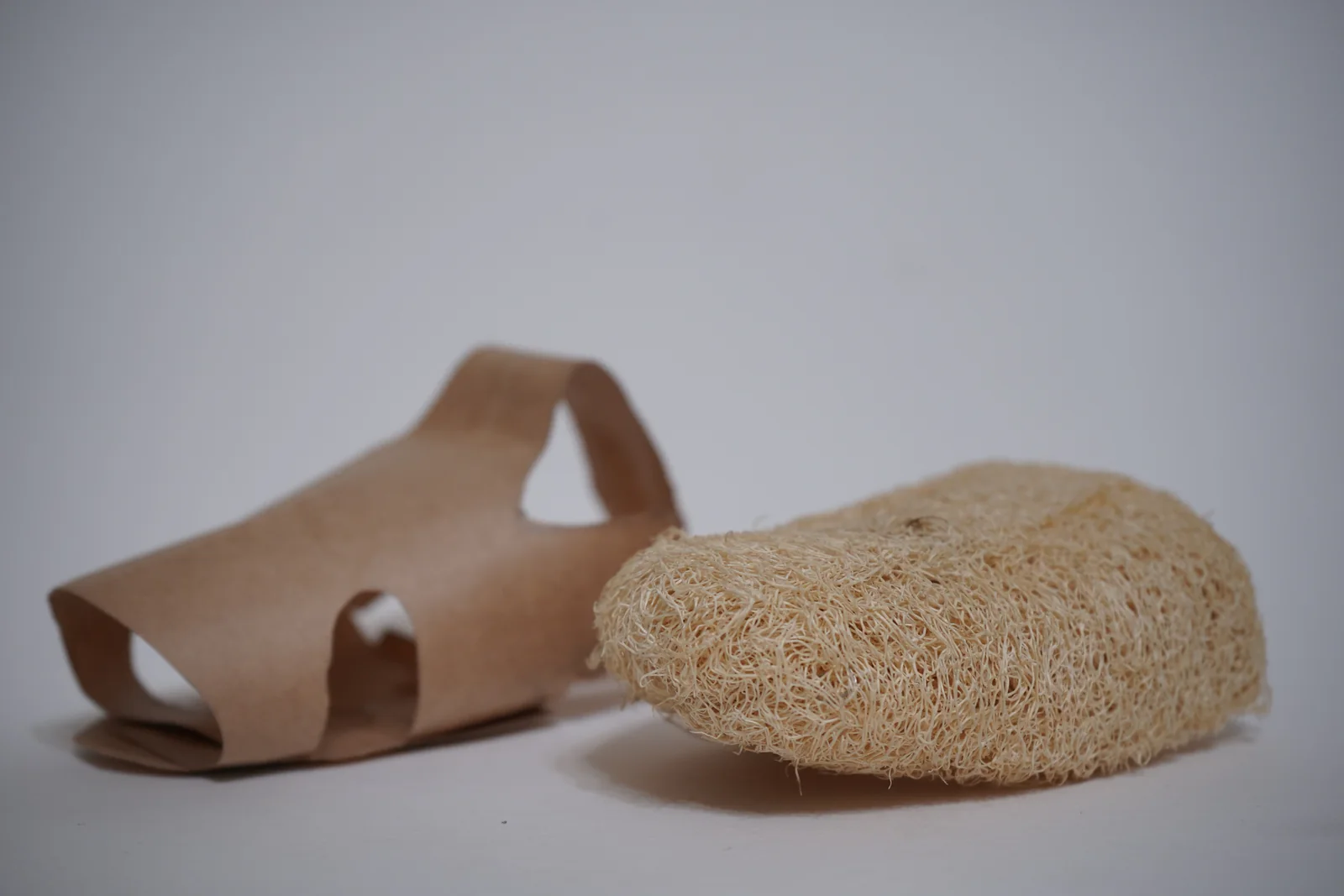
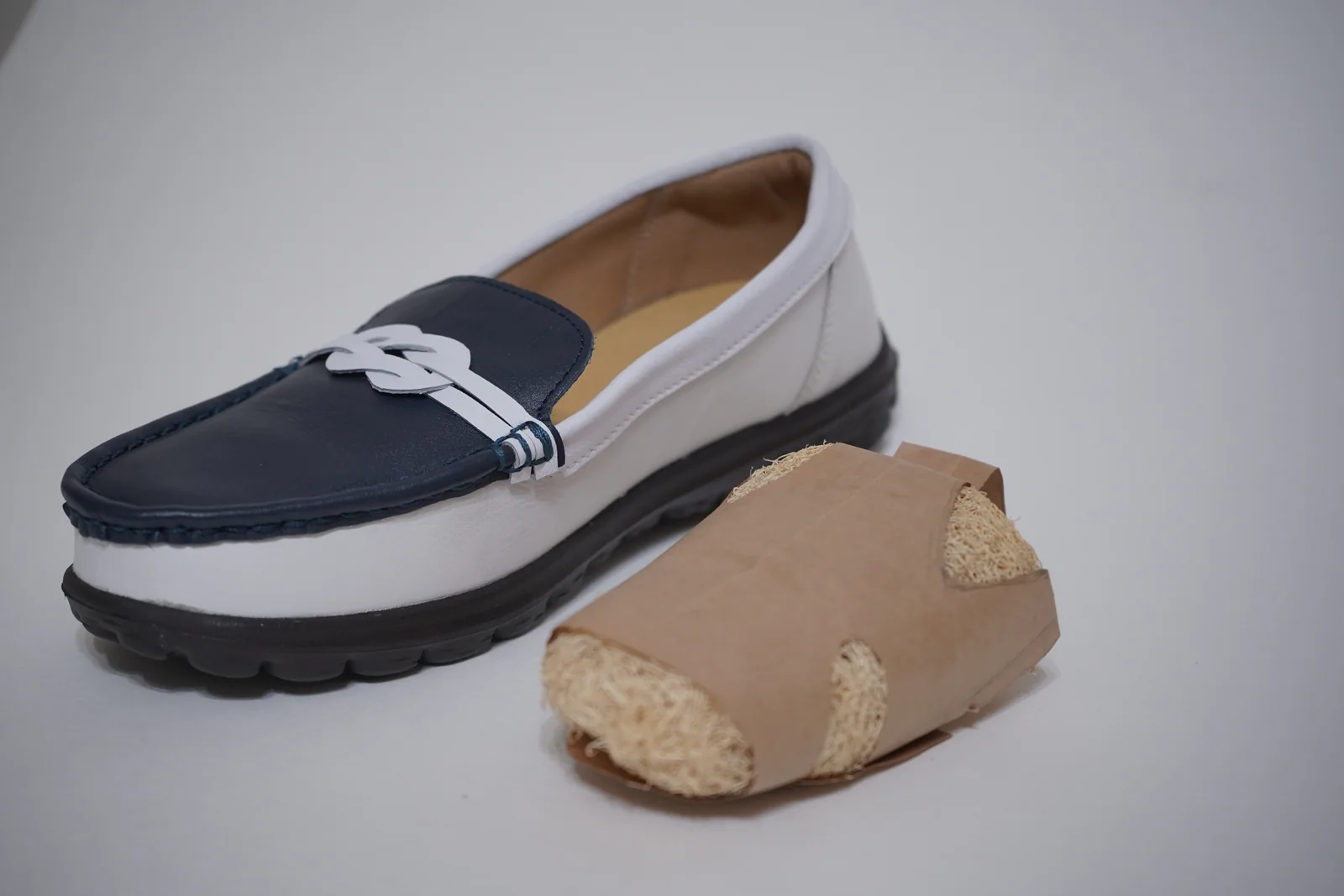
One loofah part sits under the foot. Another goes into a new shoe during packing or display to hold the toe in shape.

A loafer beside a formed tan toe support with exposed loofah at both ends.
The assembled toe support, with loofah visible in its shell, is placed next to the shoe it was shaped to fill.
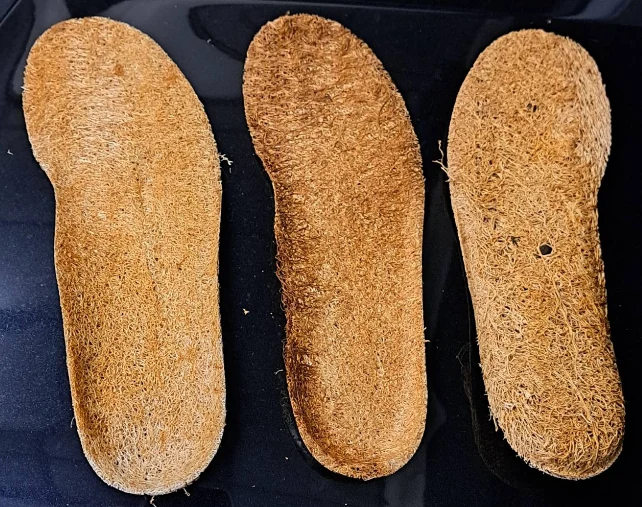
Three shaped loofah insoles arranged side by side on a dark surface.
Three full-length loofah insoles show the heel-to-toe shape used underfoot.

Take out the support before wearing

Inside a new shoe, the removable support holds the front of the upper in shape for display or storage. When the shoe is ready to wear, the insert can be taken out.

Once removed, the loofah piece can be kept for scrubbing, giving that packing component a second use.

Designed to replace
EVA / PU foam insoles, and disposable plastic-foam toe supports inserted into new shoes.
Progress to date
Samples of both parts, with a 2022 Paris exhibition record for the insoles.
What we plan to measure
Test how the insole fits and compresses over repeated wear, and measure how often recipients reuse the removable insert after unpacking.
Design notes and sources

Two parts for the same shoe

Foam is commonly used both inside footwear and in removable packing pieces. The team used loofah for a full-length insole and shaped a smaller piece to sit at the toe of the shoe.

A formed tan toe-support prototype and a separate loofah footwear piece placed side by side.
The folded shell and loofah insert shown apart, before they are fitted into the shoe.

The insole sits where the foot lands

Loofah is shaped to follow the outline of the foot and placed inside the shoe, in the position normally occupied by an EVA or PU foam insole.

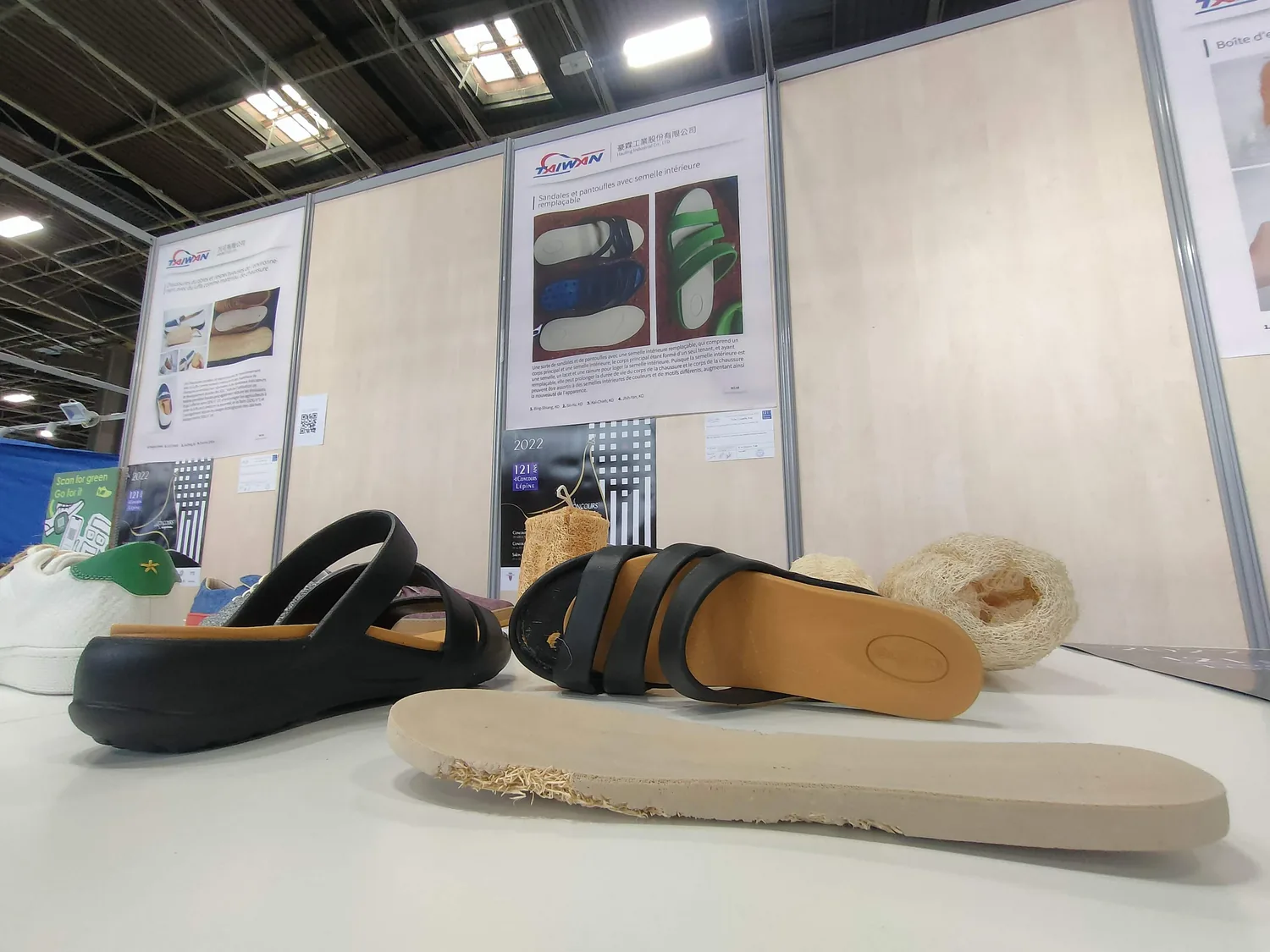
Footwear samples on display

The team's archive shows shoe samples displayed with formed loofah parts.

A display table with shoes, sandals and loofah footwear pieces at an exhibition.
Shoes, sandals and loofah footwear samples on display at the 2022 exhibition.

Documented progress

2022 public exhibition report
The published report from Taiwan's representative office in France lists loofah insoles among the delegation’s works at Concours Lépine 2022.

Stacking Dish for Everyday Bowls

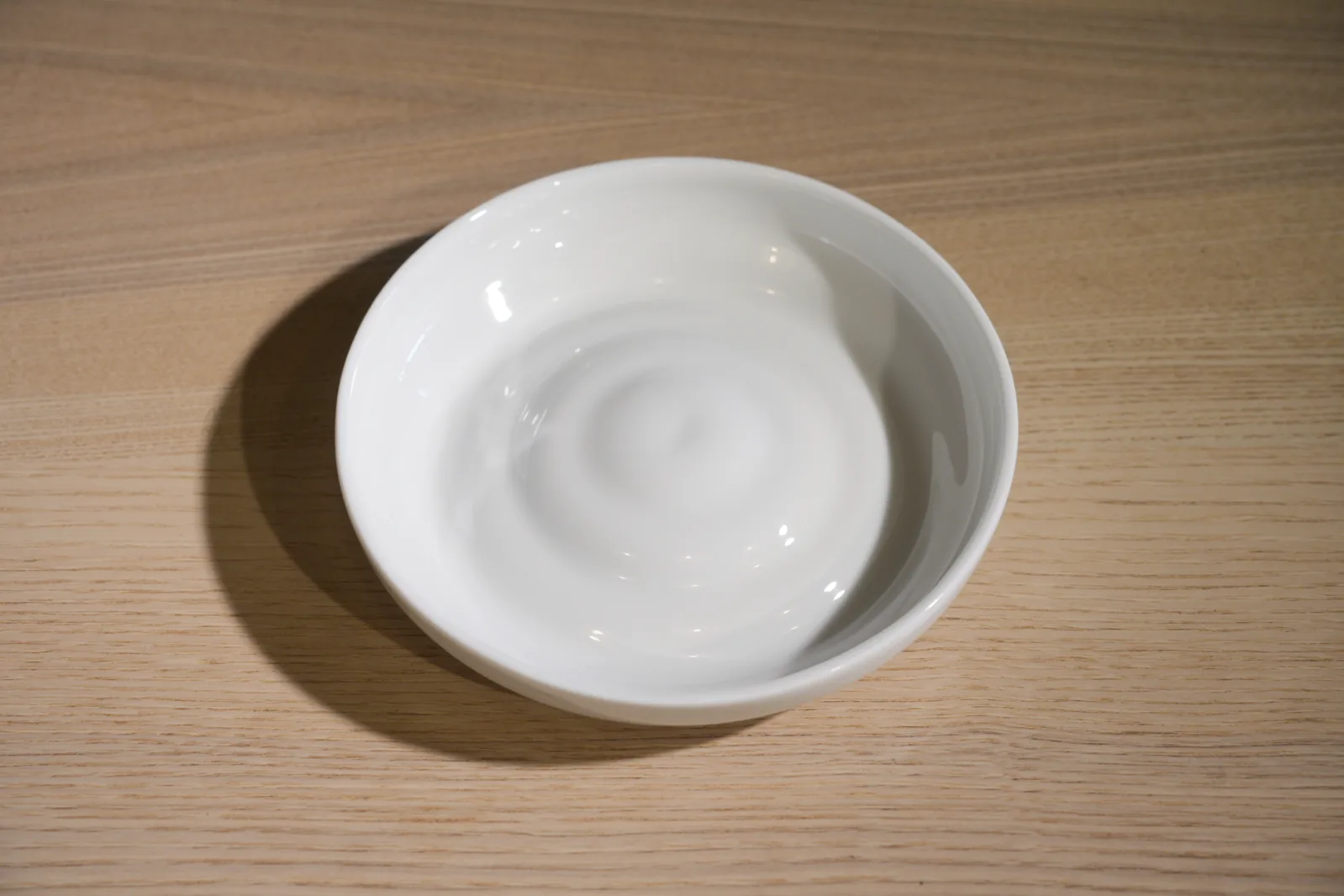
Set the dish on a bowl to cover it. The circular track gives a second bowl a place to sit, so the bowls you already own can be stacked.

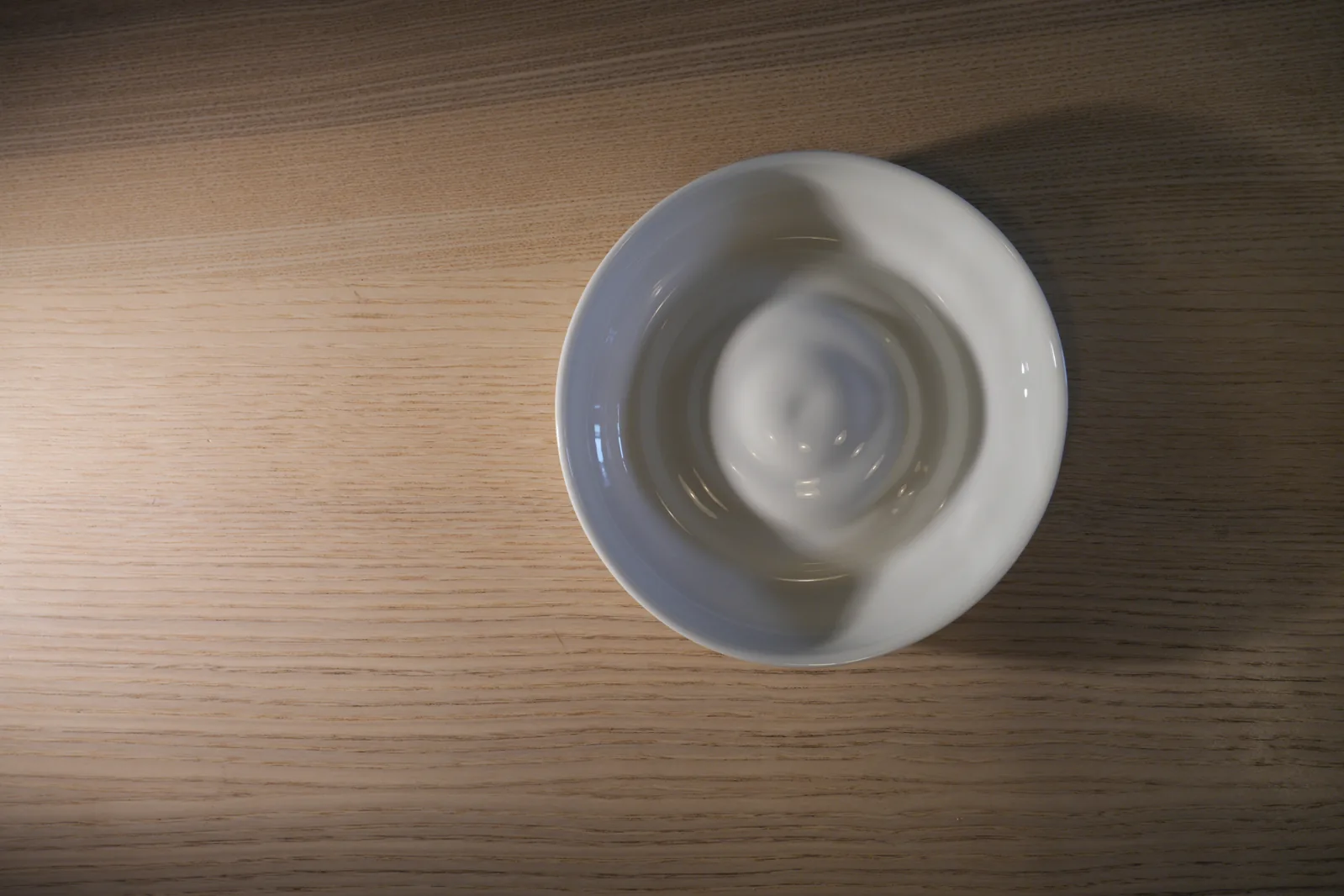
A glossy white ceramic dish with concentric raised rings on a wood table.
The ceramic dish resting on a tabletop, with the concentric profile visible before it is placed over a bowl.

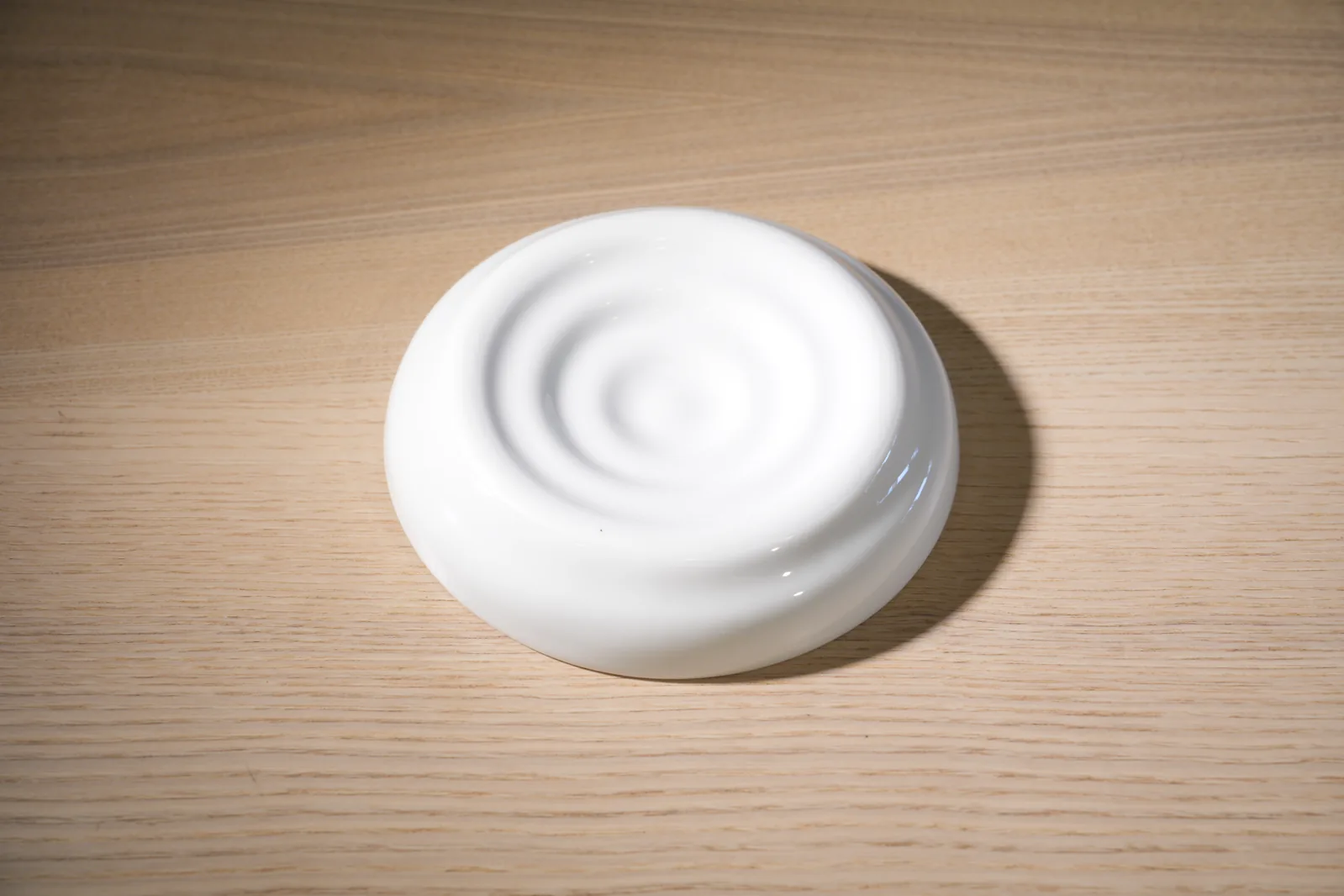
The ring is the interface

The concentric shape fits the rim or base of a compatible round bowl. Matching the ring to the bowl gives each item a defined resting point when the layers are stacked.

Designed to replace
Disposable cling film used to cover food in compatible round bowls.
Progress to date
Ceramic and moulded versions, with Paris exhibition records from 2025 and 2026.
What we plan to measure
The next test is to compare fit and stability across common round-bowl sizes, then track how often households use the dish in place of film.
Design notes and sources

A familiar bowl, with a second job

Leftovers often go from a bowl into a new container or under a sheet of cling film. This dish covers the food in the same bowl you used to serve it.

The underside of the white ceramic dish, showing its concentric raised rings.
The ceramic dish turned over. The raised rings give a compatible bowl a place to sit when the pieces are stacked.

Ceramic and moulded versions

The team showed curved and stepped variants of the ceramic dish in a 2026 crowdfunding campaign. A moulded version demonstrates how the same principle can work with several bowl shapes.

A white ceramic bowl-dish form photographed from above on a wood table.
An overhead view of the glazed ceramic version shows the rim and the shallow serving surface.

From counter to refrigerator

  1. Place the dish over a compatible round bowl when covering prepared food.
  2. Set another compatible bowl on the upper ring.
  3. Lift the top bowl to access the one beneath it.
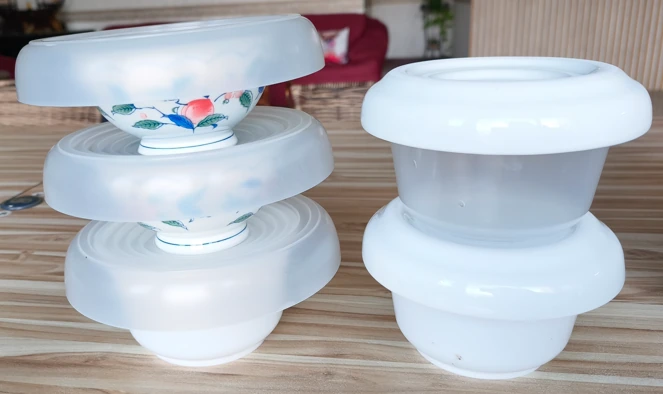
Two stacks of different round bowls separated by translucent moulded dishes.
The application photograph shows translucent moulded samples between two sets of round bowls.

Documented progress

2025 public recognition
National United University reports that design students 詹雅晴 and 郭芷暄 worked with 偉鵬科技. The department records a 2025 Paris bronze medal and identifies the Taiwanese utility-model certificate M669162.

2026 patent exhibit
Taiwan InnoTech Expo lists National United University’s stacking dish as a 2026 Paris gold-medal work. The Taiwan delegation lists the design as entry 14.

Water-Activated Carton

A starch-based adhesive is already on the carton flap. Brush on a little water and press the flaps together to close the box.

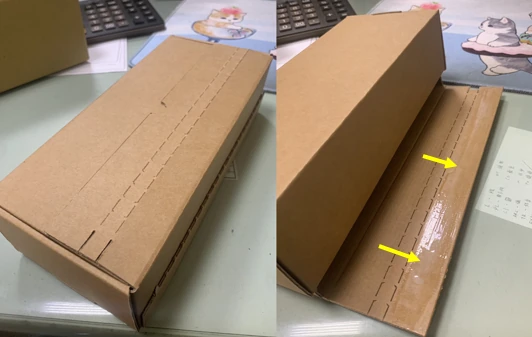
Two views of the carton prototype, with its flap closed and its prepared adhesive area exposed.
The closed carton at left and the opened flap at right. The yellow arrows indicate where the water-activated adhesive is applied.

The adhesive is already on the flap

The prototype was inspired by postage stamps. The carton can be delivered flat with a dry coating. At the packing station, water activates the prepared bonding area just before the flaps are pressed together.

Designed to replace
Plastic carton-sealing tape used to close corrugated boxes.
Progress to date
2025 Paris Silver Award · production engineering documented
What we plan to measure
To support a scale-up case, record the current production status, the carton formats that can be made, and a side-by-side closure and recycling workflow with ordinary plastic-taped cartons.
Design notes and sources

A related paper tape experiment

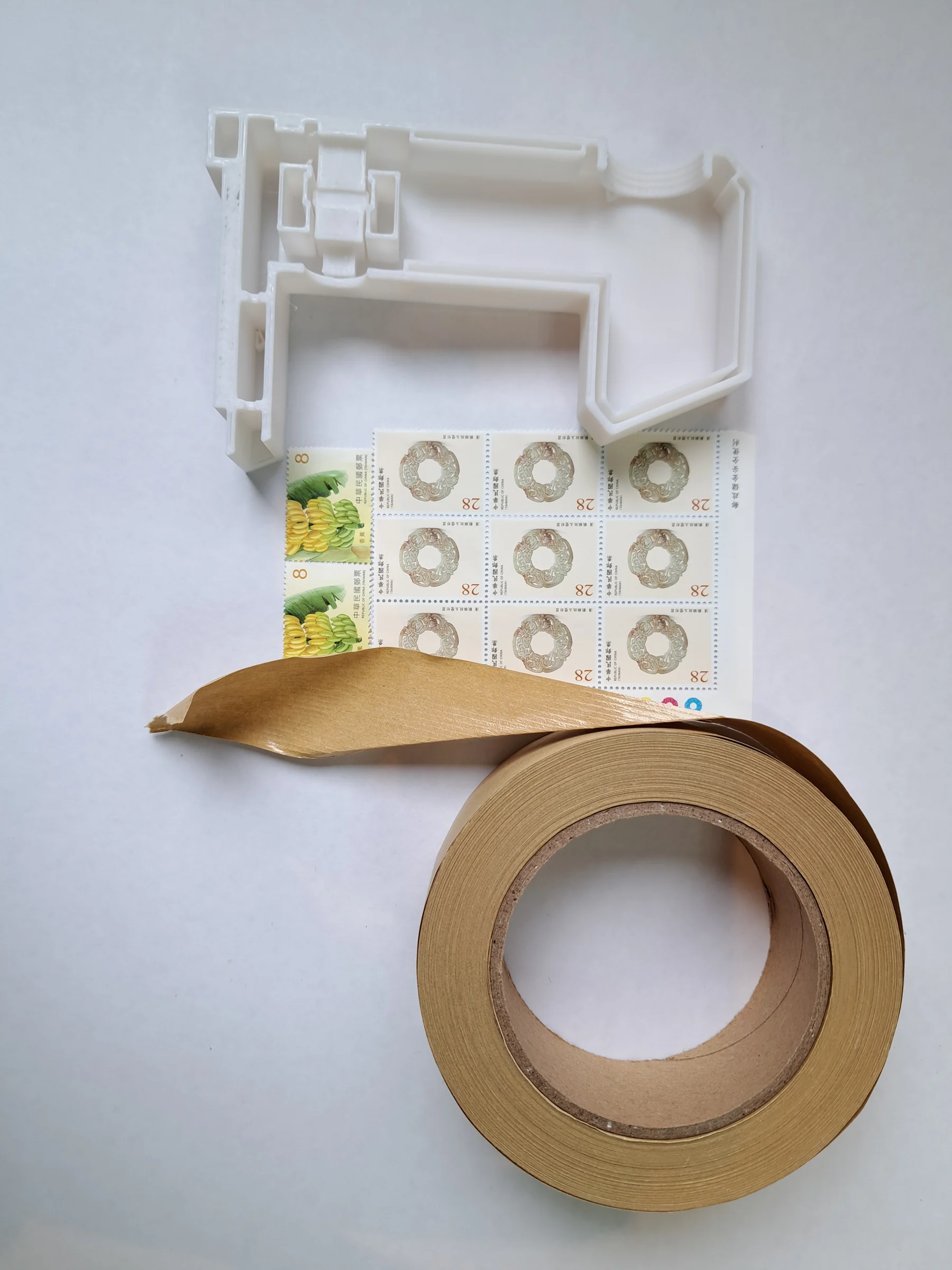
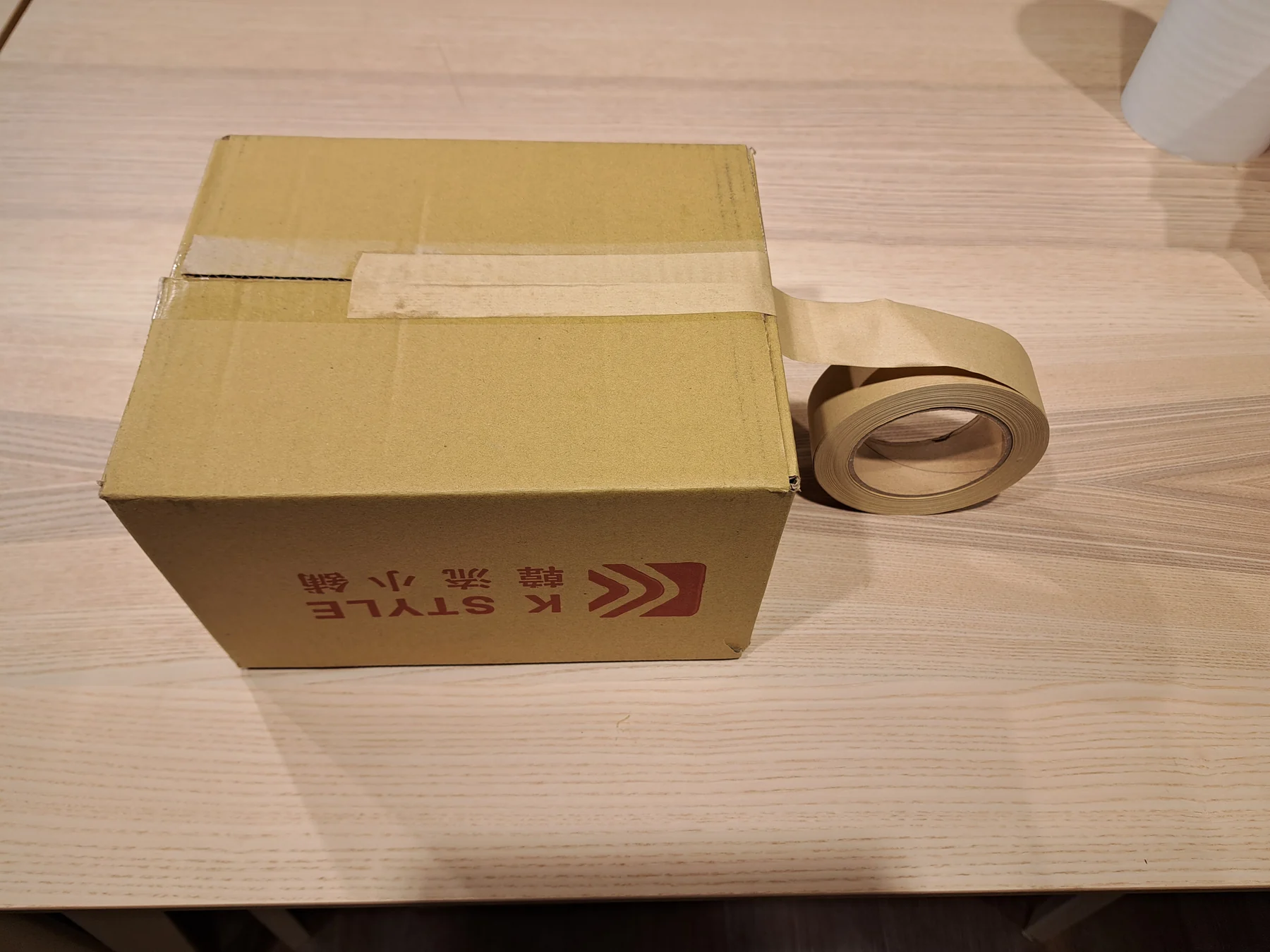
The team also presented a water-activated paper tape and applicator. The tape is a separate way to replace conventional plastic packing tape on boxes without an integrated adhesive coating.

A roll of paper carton-sealing tape next to the cutting tool
The related 2024 paper tape project pairs a roll of water-activated tape with an applicator.

From an exhibition model toward production

The 2024 Paris entry described a working model built around starch adhesive applied to specific carton zones. In 2025, the project was developed with Heya Paperware through a Miaoli SBIR collaboration and received a Silver Award at the 124th Paris International Exhibition of Inventions.

The university describes tooling improvements to apply the coating on a trial production line.

A closed cardboard carton with a paper adhesive roll beside it
The taped seam and the separate paper tape roll are visible together in this view of the carton study.

Documented progress

2024 Paris entry record
The local entry record for work 53 identifies HOZZY plastic-free ecological packaging cartons and describes a starch-based adhesive on predetermined areas that is activated with a small amount of water. It records a working model at that time.

2025 public recognition
National United University and Miaoli County public reports identify the carton project developed with Heya Paperware as a Silver Award recipient at the 124th Paris International Exhibition of Inventions.

Reusable Silicone Sous Vide Bag

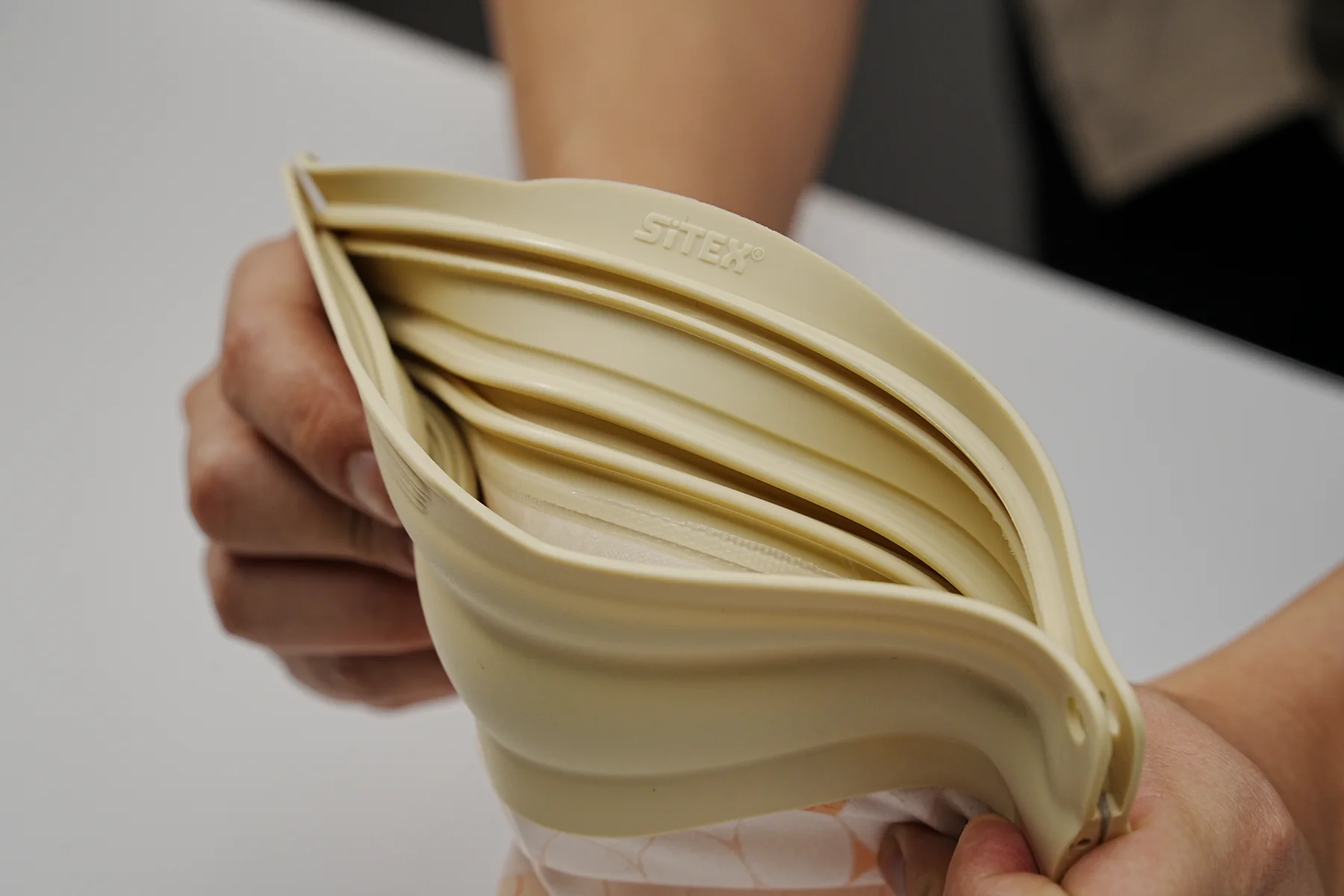
The Zentient Si-Tex bag uses two zippers and a pump port. After cooking or storage, the silicone bag can be washed and used again.

Hands opening a cream silicone vacuum bag, with the layered closure marked Si-Tex.
The open Si-Tex silicone bag shows the two zipper channels at its mouth.

The port turns sealing into a sequence

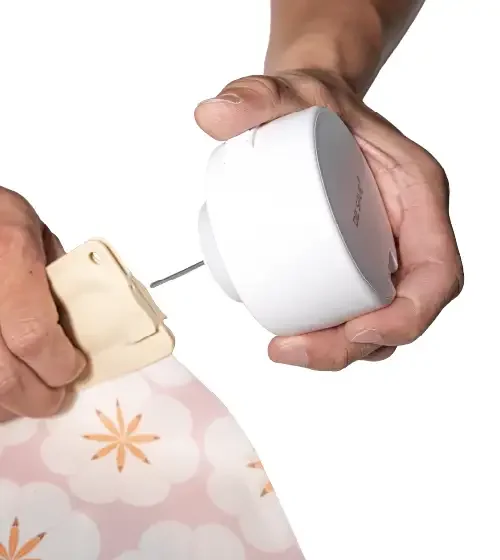
  1. Insert the vacuum pump into the marked port.
  2. Start the pump and let the bag draw in around its contents.
  3. Close the second zipper once the vacuum is complete, then remove the pump.
Designed to replace
A single-use plastic vacuum bag used once for the same preparation or storage task.
Progress to date
2026 Paris entry #48 · operating sequence documented
What we plan to measure
A kitchen trial could record how many disposable bags are replaced and measure the handling and washing effort over repeated use.
Design notes and sources

One bag, two closure lines

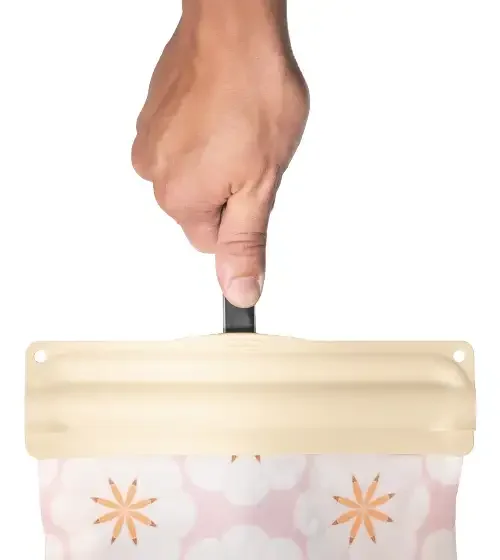
Open the soft bag to add the food, then close the first zipper. The second zipper stays open while the pump draws air out through the port.

The manufacturer's first instruction image shows the top edge of the silicone bag with a hand above it.
The illustrated instructions start by placing the contents inside the open bag.
A white vacuum pump being positioned at the bag's dedicated port.
The white vacuum pump lines up with the port at the end of the zipper.

The next use starts with a clean cycle

After use, open both zippers and wash the bag according to the product instructions. The same bag can then return to storage or the next preparation.

The patterned silicone vacuum bag shown closed with its contents held against the bag wall.
The pump has been removed, leaving the patterned silicone bag closed around its contents.

Documented progress

Paris entry identity
The 2026 Taiwan delegation lists Zentient Si-Tex as its sous vide bag entry, number 48.

Owner instructions
The HOZZY manual shows the pump connection and the order in which the two zippers close.

Washable Fabric Mask

A cloth face covering shifts the everyday routine from discard-after-use to wash, dry, and wear again.

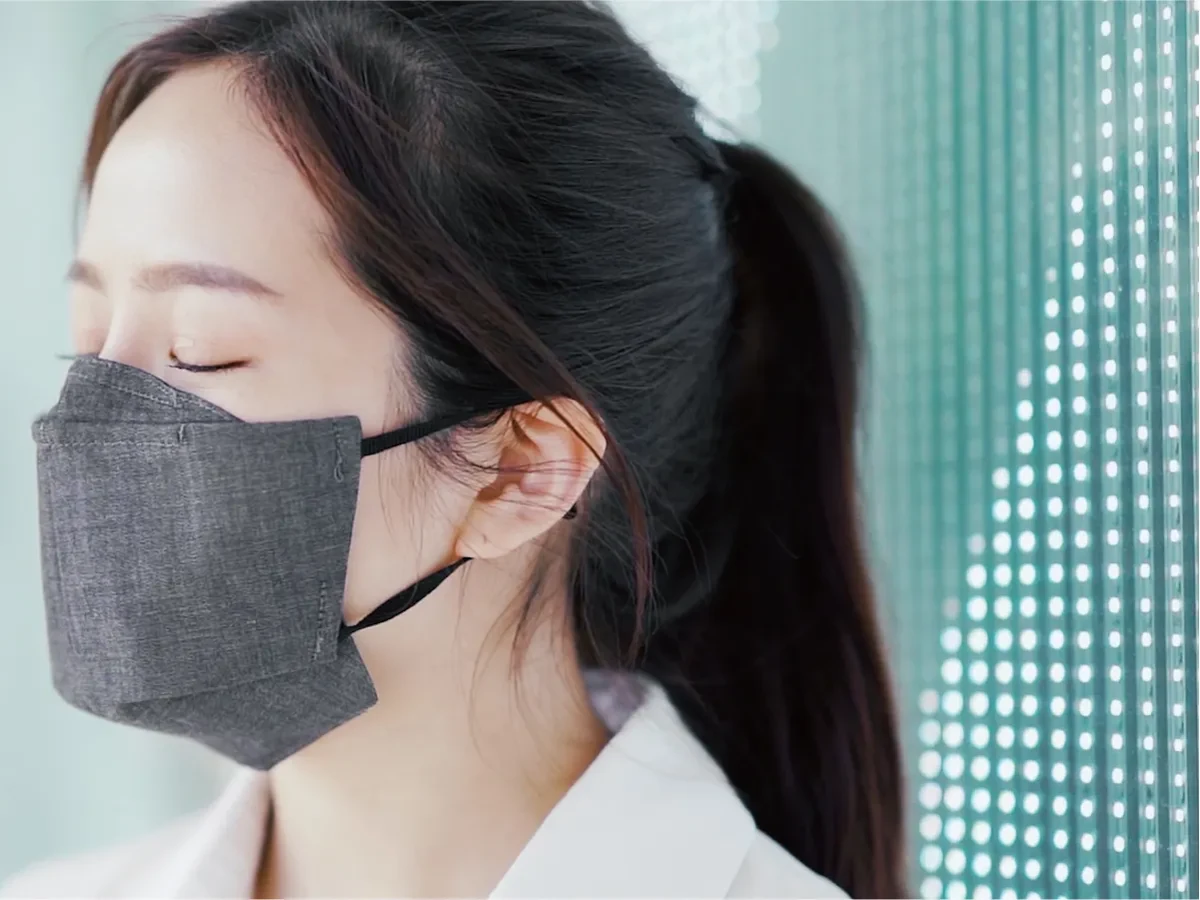
A person wearing the gray HOZZY textile mask in profile.
The grey HOZZY cloth mask in profile, with the front panel and elastic ear loop visible.

Shape makes the textile usable

A folded textile panel forms the three-dimensional shape and attaches to loops on each side. The construction and fastenings are visible in the product views.

Designed to replace
Single-use disposable masks used in routine, non-clinical settings.
Progress to date
Washable textile product documented by HOZZY.
What we plan to measure
A user trial could record the number of wears and washes, how often participants keep the mask in use, and what is discarded at the end.
Design notes and sources

The waste pattern is a routine

The textile mask is designed to be worn, washed and dried between uses. It makes routine care part of the product’s design.

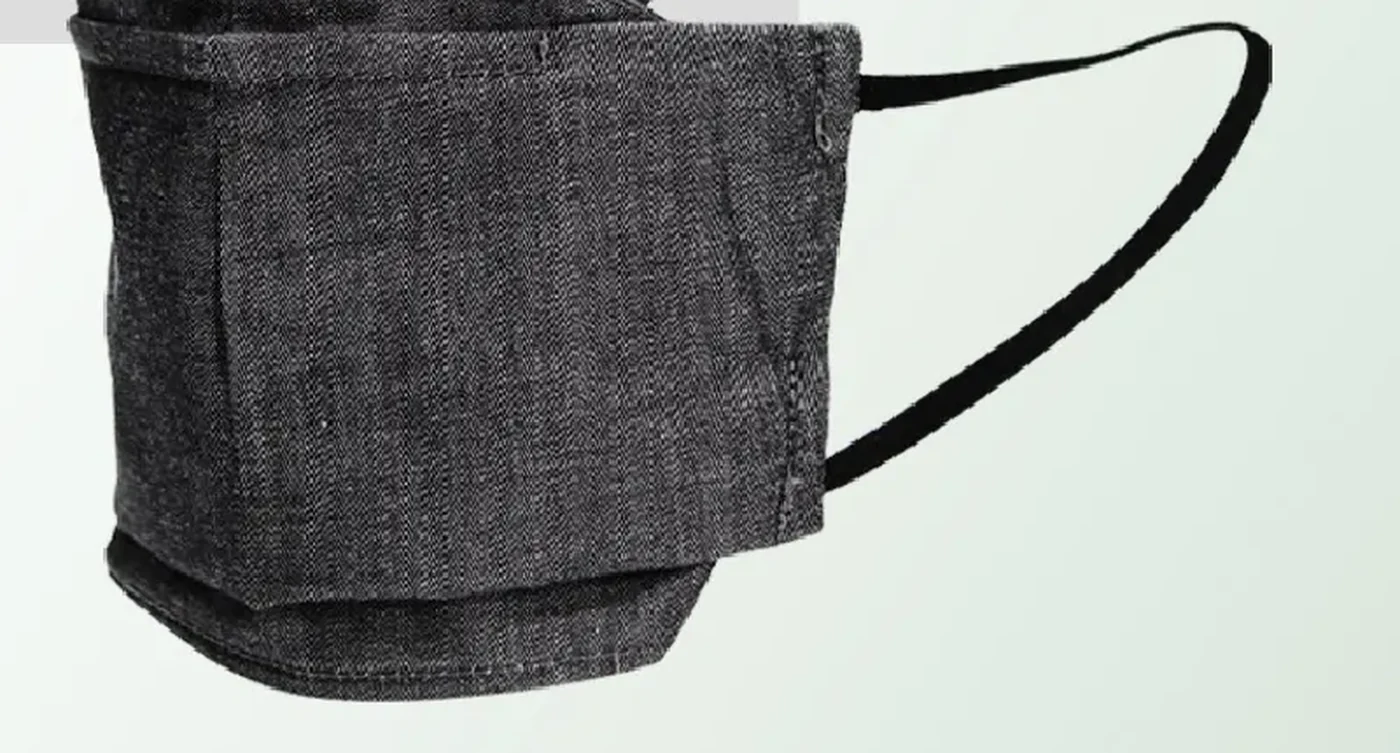
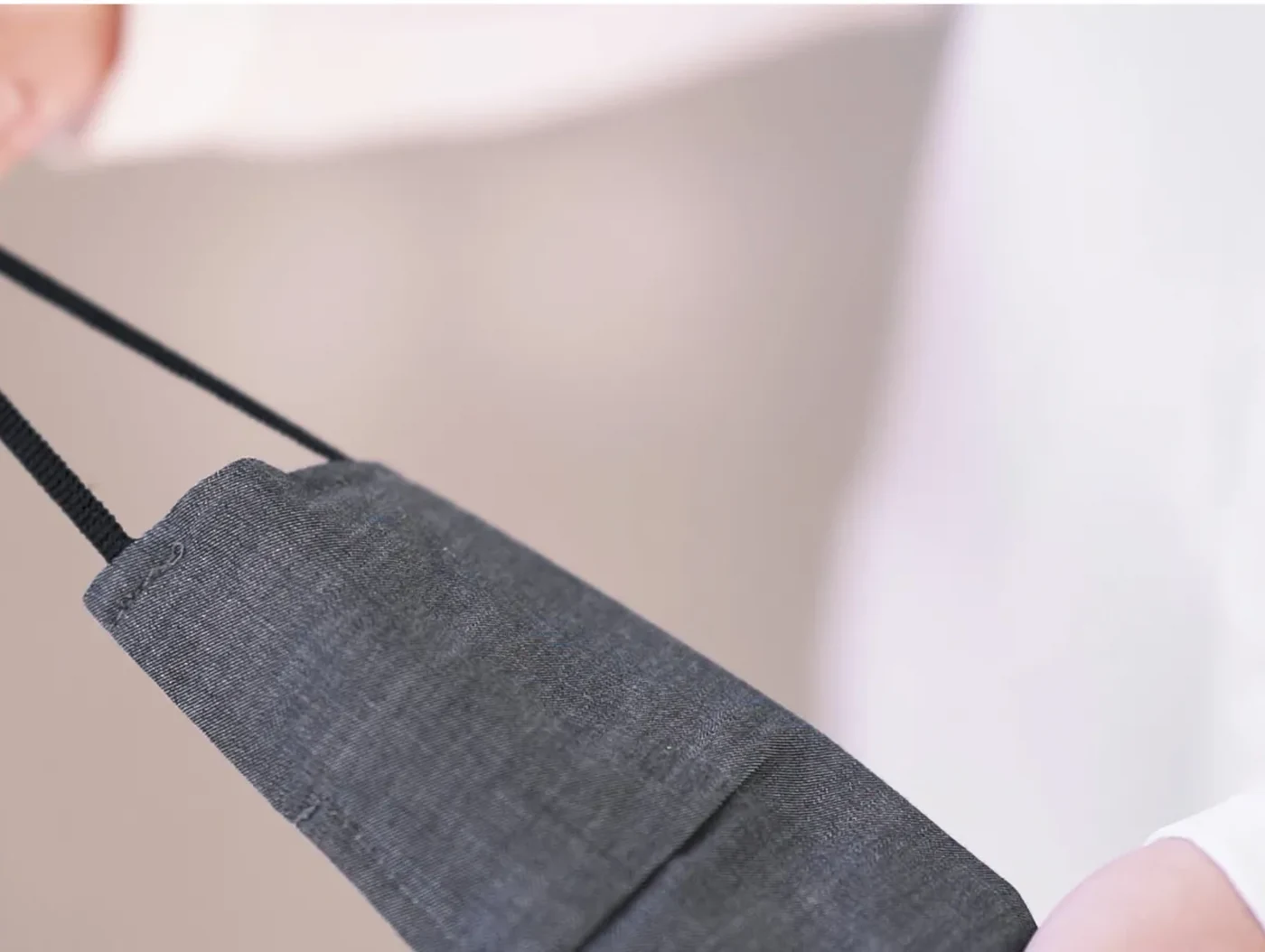
A gray fabric mask shown as a shaped object, with its side loop visible.
Off the face, the folded front panel and the elastic loop are visible.

A woven textile surface

The close-up shows the fabric surface people handle while wearing, putting away and cleaning the mask.

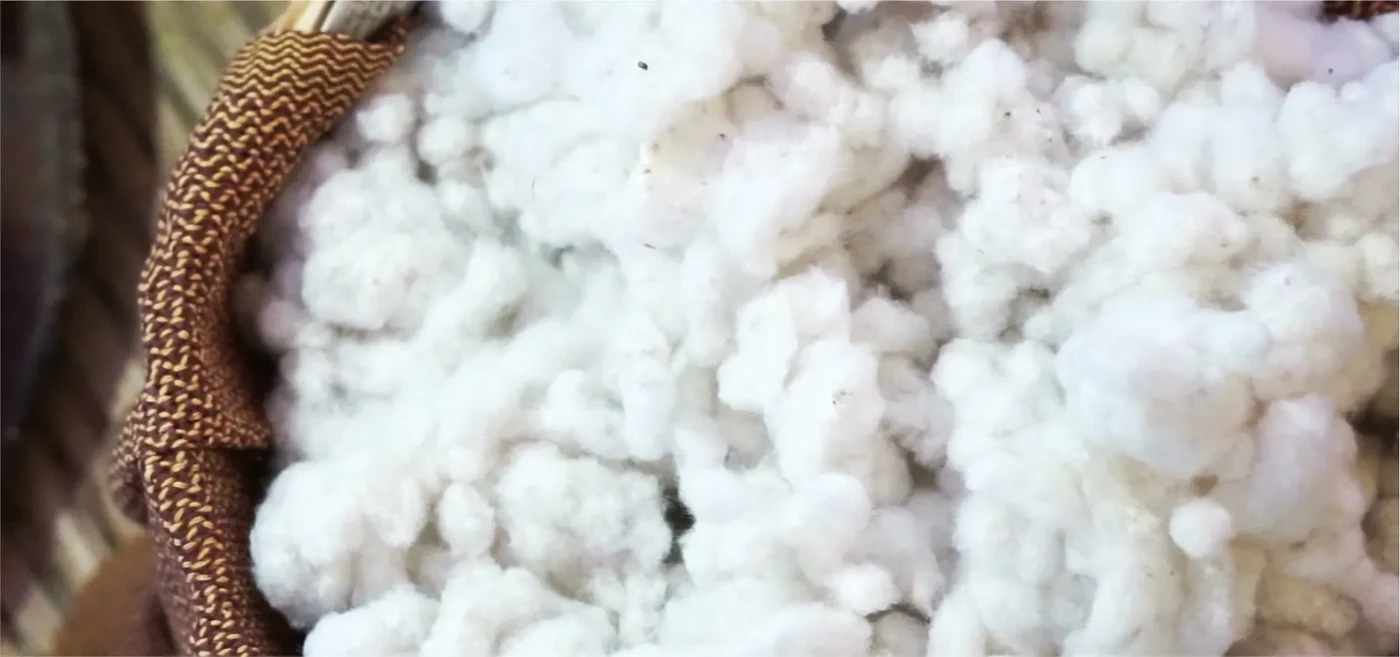
A close-up of light fibres next to a dark woven edge from the product's material photography.
The material close-up shows the texture of the light fibres next to the woven edge.

Use, wash, repeat

  1. Wear it for the ordinary, non-clinical situation it was designed to serve.
  2. Remove it and wash it according to the product care instructions.
  3. Dry it fully, then return the same mask to the next use cycle.
A hand holds the gray mask by its two side loops, showing the textile body.
Held by the loops, the mask hangs open to show the shape of its fabric body.

Documented progress

Owner product record
HOZZY’s product page shows the grey fabric mask and describes washing it for repeat use.

Bamboo-Fiber Tableware Series

A bamboo-fibre material is shaped into the things people already reach for at a table, from cups and bowls to chopsticks and spoons.

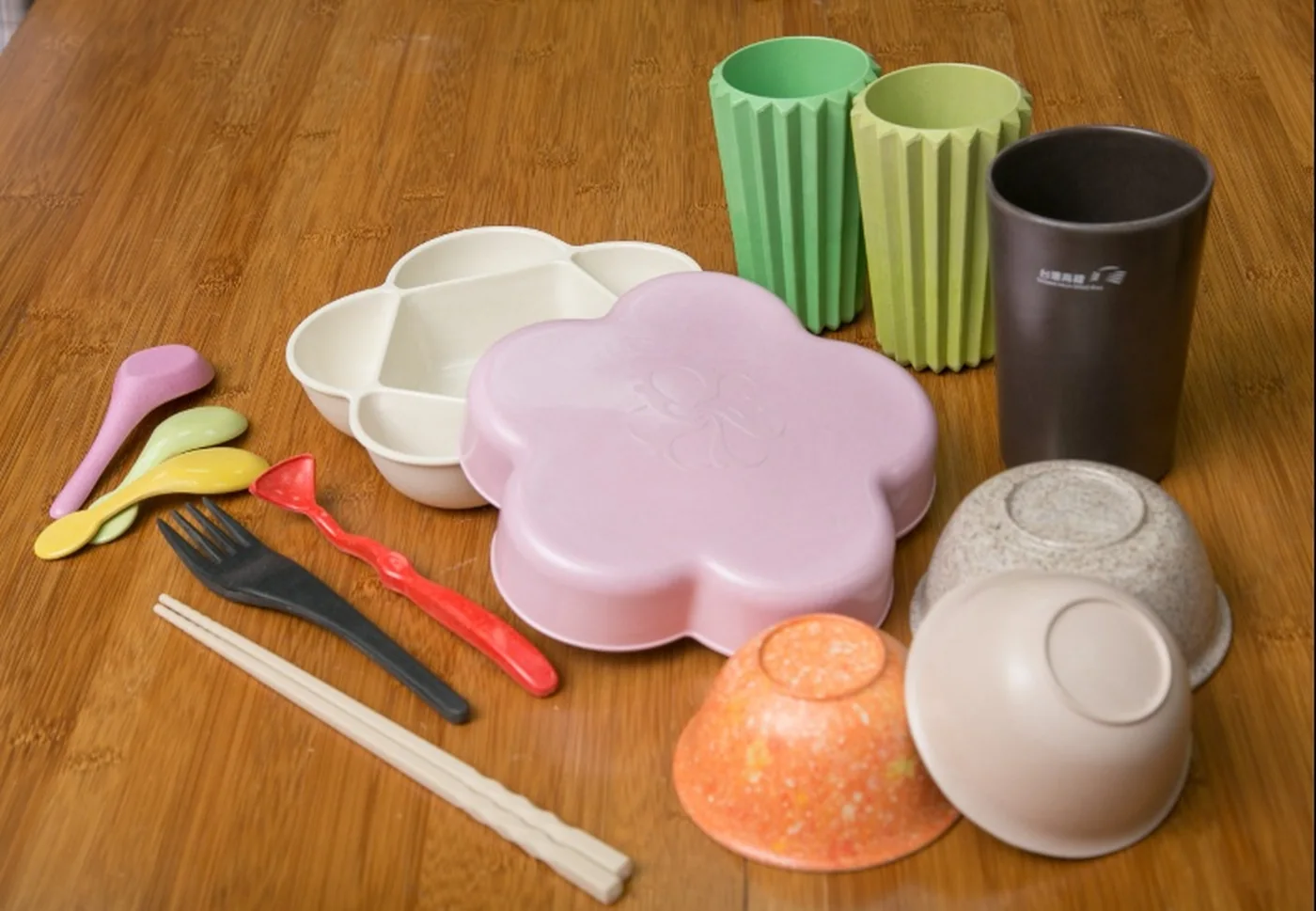
Colorful bowls, cups, plates, spoons, forks and chopsticks on a bamboo-toned tabletop.
More forms from the same series, including a flower-shaped plate, fluted cups and moulded utensils.

A family of familiar tableware

The tableware includes vessels for serving and drinking, alongside utensils for eating. The familiar shapes let the series explore material changes within existing food-service routines.

Designed to replace
Selected fossil-plastic or disposable food-service items, depending on the exact form and use.
Progress to date
Formed tableware samples and a documented plant-fibre development programme.
What we plan to measure
A food-service trial can start with a specific cup or utensil, document its composition and required food-contact tests, then track what it replaces and how it is handled after use.
Design notes and sources

Fit the way a table works

Plates stack, cups can be gripped, and bowls have the depth needed for serving. Each item makes a distinct set of demands on the material and its form.

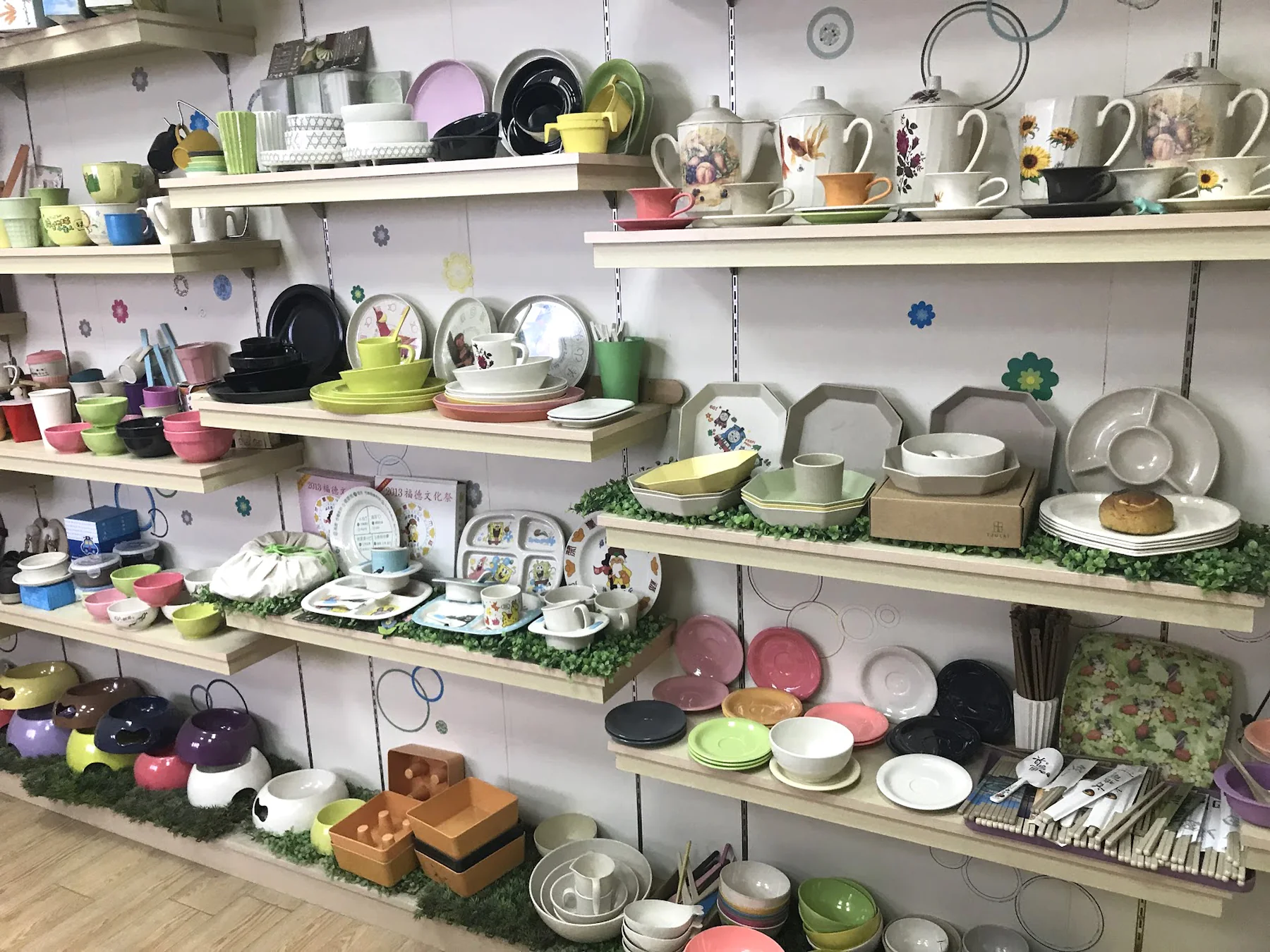
A display shelf filled with cups, bowls, plates and other food-service forms in many colours.
A display from the project archive shows several sizes and colours of bowls, cups and plates.

Turn fibres into formed objects

Taiwanese manufacturer EASON describes several ways to form plant fibres, including injection moulding for complex shapes and extrusion for straws. The method depends on the type of item.

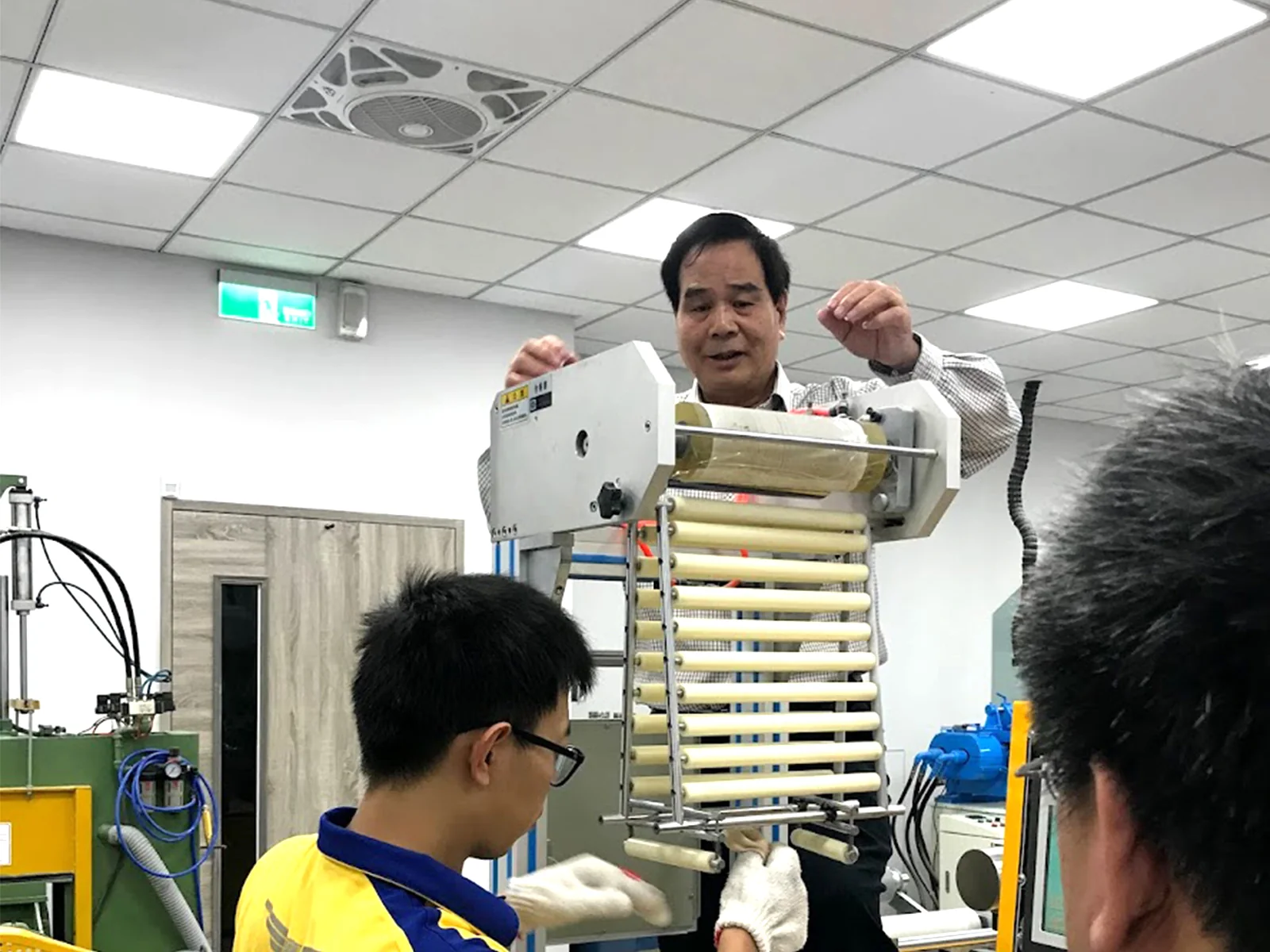
People and equipment in a workshop scene from the supplied tableware record.
A workshop photograph from the project archive with a rack of samples held up for the group.

Documented progress

Official material direction
EASON’s company and technical pages identify bamboo fibre among its materials and list cups, straws and food containers as applications for plant fibres.

Ten designs in use

See how the ten designs change everyday tasks and what Team V-Flock plans to measure next.

Read the transcript

Team V-Flock

The team takes its name from birds that take turns leading a V formation. Each Taiwanese inventor or design team leads one part of this shared effort.